Question: a Case Study: Networking Infrastructure for an Educational Institution Background: Greenwood College is a medium-sized educational institution with approximately 500 students and 50 staff members.
a
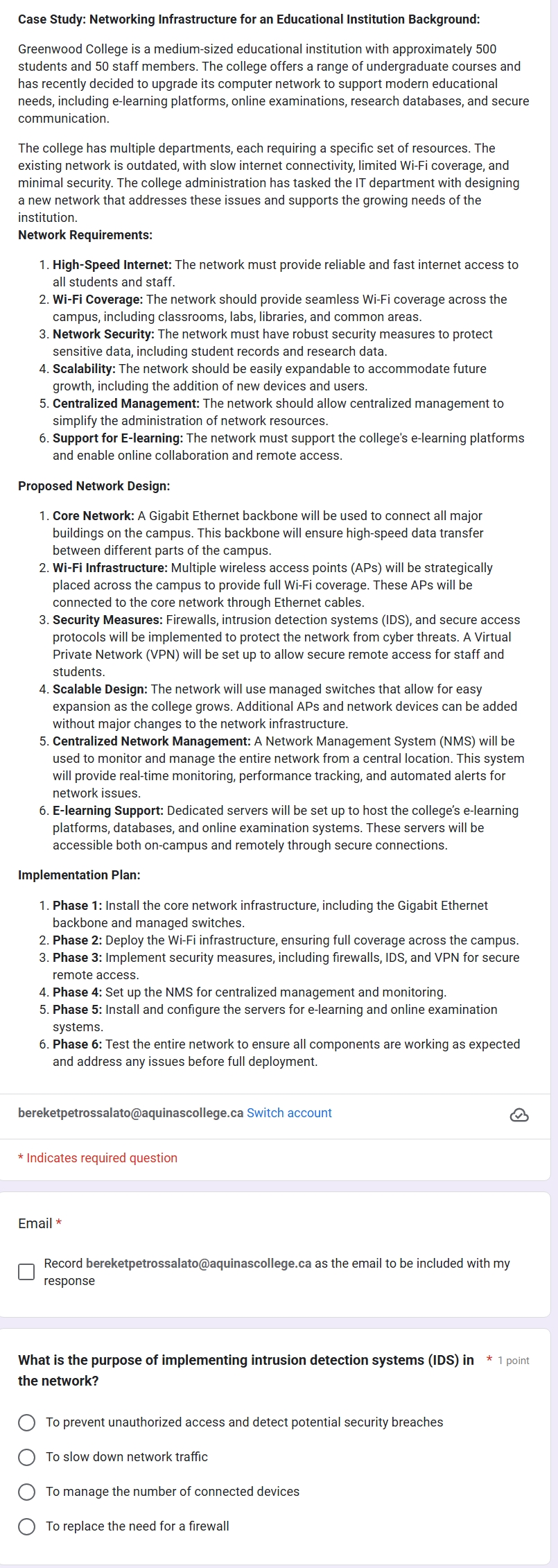
Case Study: Networking Infrastructure for an Educational Institution Background: Greenwood College is a medium-sized educational institution with approximately 500 students and 50 staff members. The college offers a range of undergraduate courses and has recently decided to upgrade its computer network to support modern educational needs, including e-learning platforms, online examinations, research databases, and secure communication. The college has multiple departments, each requiring a specific set of resources. The existing network is outdated, with slow internet connectivity, limited Wi-Fi coverage, and minimal security. The college administration has tasked the IT department with designing a new network that addresses these issues and supports the growing needs of the institution. Network Requirements: 1. High-Speed Internet: The network must provide reliable and fast internet access to all students and staff. 2. Wi-Fi Coverage: The network should provide seamless Wi-Fi coverage across the campus, including classrooms, labs, libraries, and common areas. 3. Network Security: The network must have robust security measures to protect sensitive data, including student records and research data. 4. Scalability: The network should be easily expandable to accommodate future growth, including the addition of new devices and users. 5. Centralized Management: The network should allow centralized management to simplify the administration of network resources. 6. Support for E-learning: The network must support the college's e-learning platforms and enable online collaboration and remote access. Proposed Network Design: 1. Core Network: A Gigabit Ethernet backbone will be used to connect all major buildings on the campus. This backbone will ensure high-speed data transfer between different parts of the campus. 2. Wi-Fi Infrastructure: Multiple wireless access points (APs) will be strategically placed across the campus to provide full Wi-Fi coverage. These APs will be connected to the core network through Ethernet cables. 3. Security Measures: Firewalls, intrusion detection systems (IDS), and secure access protocols will be implemented to protect the network from cyber threats. A Virtual Private Network (VPN) will be set up to allow secure remote access for staff and students. 4. Scalable Design: The network will use managed switches that allow for easy expansion as the college grows. Additional APs and network devices can be added without major changes to the network infrastructure. 5. Centralized Network Management: A Network Management System (NMS) will be used to monitor and manage the entire network from a central location. This system will provide real-time monitoring, performance tracking, and automated alerts for network issues. 6. E-learning Support: Dedicated servers will be set up to host the college's e-learning platforms, databases, and online examination systems. These servers will be accessible both on-campus and remotely through secure connections. Implementation Plan: 1. Phase 1: Install the core network infrastructure, including the Gigabit Ethernet backbone and managed switches. 2. Phase 2: Deploy the Wi-Fi infrastructure, ensuring full coverage across the campus. 3. Phase 3: Implement security measures, including firewalls, IDS, and VPN for secure Temote access. 4. Phase 4: Set up the NMS for centralized management and monitoring. 5. Phase 5: Install and configure the servers for e-learning and online examination systems. 6. Phase 6: Test the entire network to ensure all components are working as expected and address any issues before full deployment. bereketpetrossalato@aquinascollege.ca Switch account ea * Indicates required question Email * oO Record bereketpetrossalato@aquinascollege.ca as the email to be included with my response What is the purpose of implementing intrusion detection systems (IDS) in * 1 point the network? O To prevent unauthorized access and detect potential security breaches ) To slow down network traffic oO To manage the number of connected devices oO To replace the need for a firewall









 Study Help