







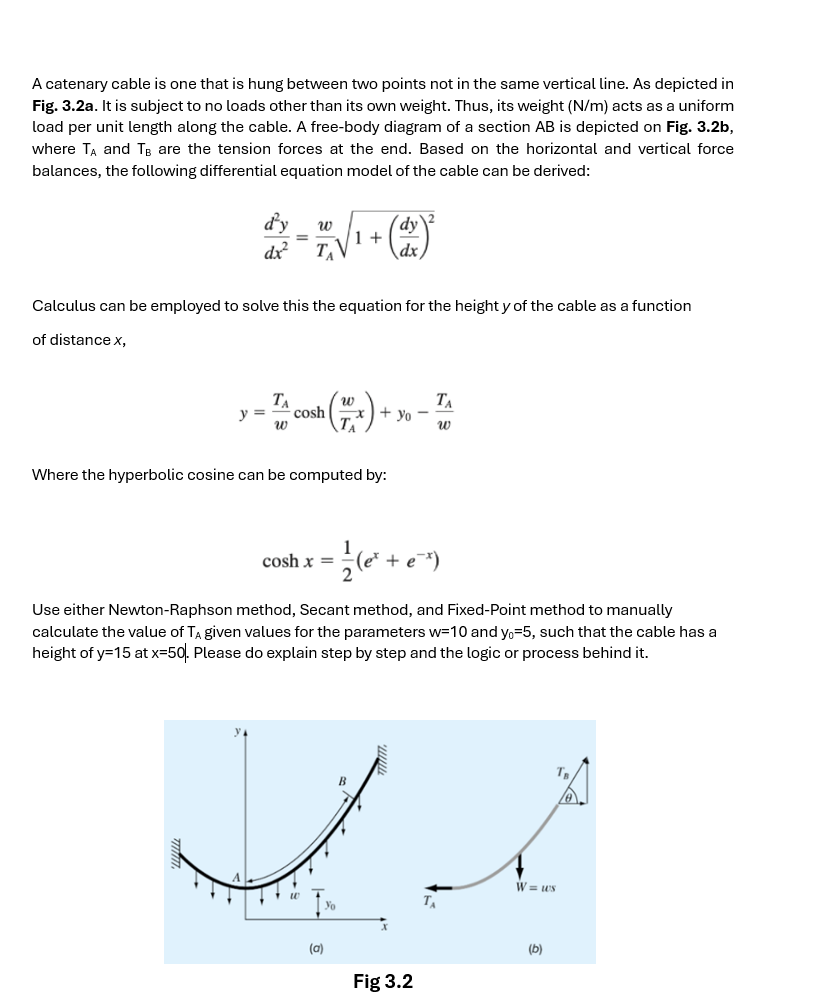
Question: A catenary cable is one that is hung between two points not in the same vertical line. As depicted in Fig. 3 . 2 a
A catenary cable is one that is hung between two points not in the same vertical line. As depicted in
Fig. a It is subject to no loads other than its own weight. Thus, its weight acts as a uniform
load per unit length along the cable. A freebody diagram of a section is depicted on Fig. b
where and are the tension forces at the end. Based on the horizontal and vertical force
balances, the following differential equation model of the cable can be derived:
Calculus can be employed to solve this the equation for the height of the cable as a function
of distance
Where the hyperbolic cosine can be computed by:
Use either NewtonRaphson method, Secant method, and FixedPoint method to manually
calculate the value of given values for the parameters and such that the cable has a
height of at Please do explain step by step and the logic or process behind it
Step by Step Solution
There are 3 Steps involved in it
1 Expert Approved Answer
Step: 1 Unlock

Question Has Been Solved by an Expert!
Get step-by-step solutions from verified subject matter experts
Step: 2 Unlock
Step: 3 Unlock
 Study Help