







Question: A. Ch. 3-Overflow We are given hexadecimal (hex) numbers as shown below -these represent 8-bit, signed, 2's- complement numbers. 1) First, we are given A
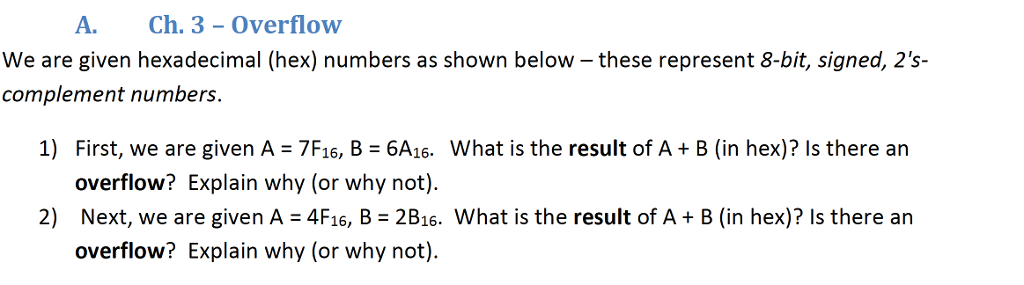
A. Ch. 3-Overflow We are given hexadecimal (hex) numbers as shown below -these represent 8-bit, signed, 2's- complement numbers. 1) First, we are given A 7F16, B 6A16. What is the result of A B (in hex)? Is there an overflow? Explain why (or why not) 2) Next, we are given A 4F16, B 2B16. What is the result of A B (in hex)? Is there an overflow? Explain why (or why not)
Step by Step Solution
There are 3 Steps involved in it
1 Expert Approved Answer
Step: 1 Unlock

Question Has Been Solved by an Expert!
Get step-by-step solutions from verified subject matter experts
Step: 2 Unlock
Step: 3 Unlock
 Study Help