







Question: A channel has a flat, horizontal bottom. Its straight, vertical bounding walls have a variable, and somewhat adjustable, width w between those walls. We consider
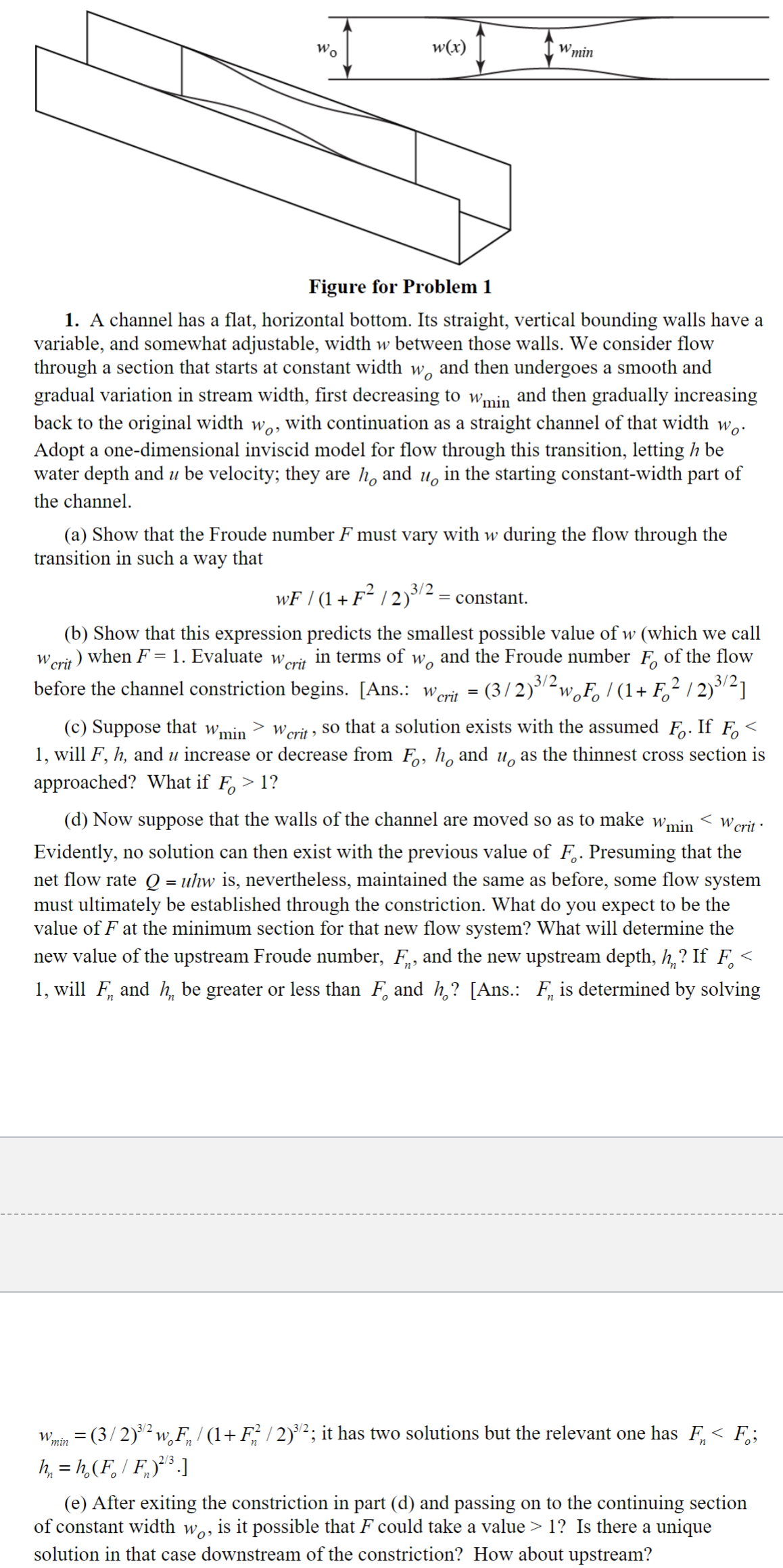
A channel has a flat, horizontal bottom. Its straight, vertical bounding walls have a variable, and somewhat adjustable, width between those walls. We consider flow through a section that starts at constant width and then undergoes a smooth and gradual variation in stream width, first decreasing to and then gradually increasing back to the original width with continuation as a straight channel of that width Adopt a onedimensional inviscid model for flow through this transition, letting be water depth and be velocity; they are and in the starting constantwidth part of the channel.
a Show that the Froude number must vary with during the flow through the transition in such a way that
constant.
b Show that this expression predicts the smallest possible value of which we call when Evaluate in terms of and the Froude number of the flow before the channel constriction begins. Ans:
c Suppose that so that a solution exists with the assumed If will and increase or decrease from and as the thinnest cross section is approached? What if
d Now suppose that the walls of the channel are moved so as to make there a unique solution that case downstream the constriction? How about upstream?
Step by Step Solution
There are 3 Steps involved in it
1 Expert Approved Answer
Step: 1 Unlock

Question Has Been Solved by an Expert!
Get step-by-step solutions from verified subject matter experts
Step: 2 Unlock
Step: 3 Unlock
 Study Help