







Question: A chicken lays n eggs. Each egg independently does or doesn't hatch, with probability p of hatching. For each egg that hatches, the chick does
A chicken lays n eggs. Each egg independently does or doesn't hatch, with probability p of hatching. For each egg that hatches, the chick does or doesn't survive (independently of the other eggs), with probability s of survival. Let N ? Bin(n, p) be the number of eggs which hatch, X be the number of chicks which survive, and Y be the number of chicks which hatch but don't survive (so X + Y = N ).(i) Find the marginal PMFs of X and Y (Hint: It is easier to derive the answer to this questionby considering the story behind the Binomial distributions. If you hope to prove this mathe-matically, you may need to use the conclusion of Binomial theorem in, namely, ?n k=0 (n k)x^k = (x + y)^n).k=0 k(ii) Find the joint PMF of X and Y , and check whether X, Y are independent.
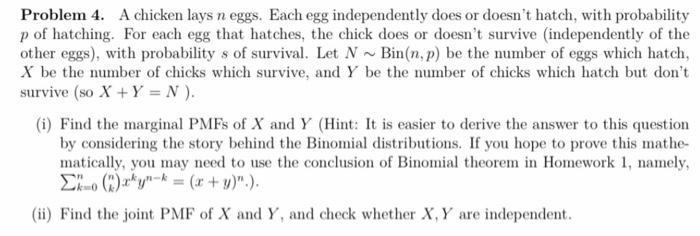
Problem 4. A chicken lays n eggs. Each egg independently does or doesn't hatch, with probability p of hatching. For each egg that hatches, the chick does or doesn't survive (independently of the other eggs), with probability s of survival. Let N ~ Bin(n, p) be the number of eggs which hatch, X be the number of chicks which survive, and Y be the number of chicks which hatch but don't survive (so X + Y = N ). (i) Find the marginal PMFs of X and Y (Hint: It is easier to derive the answer to this question by considering the story behind the Binomial distributions. If you hope to prove this mathe- matically, you may need to use the conclusion of Binomial theorem in Homework 1, namely, Co (")ky" -k = (x+ y)". ). (ii) Find the joint PMF of X and Y, and check whether X, Y are independent
Step by Step Solution
There are 3 Steps involved in it

Get step-by-step solutions from verified subject matter experts
 Study Help