







Question: A circuit has four 1-bit inputs: B3, B2. B1, and B0. It toggles its output when it recognizes at its inputs the following sequence of
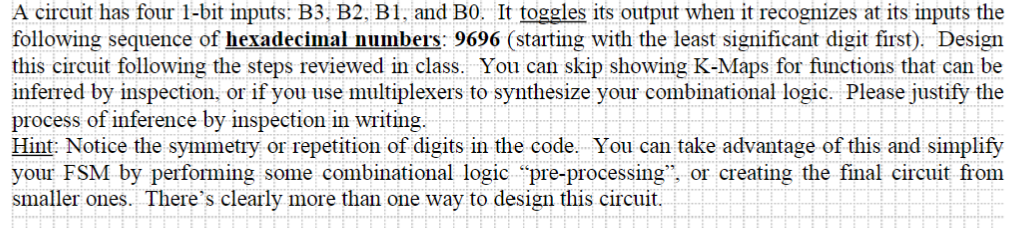
A circuit has four 1-bit inputs: B3, B2. B1, and B0. It toggles its output when it recognizes at its inputs the following sequence of hexadecimal numbers: 9696 (starting with the least significant digit first). Design this circuit following the steps reviewed in class. You can skip showing K-Maps for functions that can be inferred by inspection, or if you use multiplexers to synthesize your combinational logic. Please justify the process of inference by inspection in writing. Hint: Notice the symmetry or repetition of digits in the code. You can take advantage of this and simplify your FSM by performing some combinational logic pre-processing", or creating the final circuit from smaller ones. There`s clearly more than one way to design this circuit. A circuit has four 1-bit inputs: B3, B2. B1, and B0. It toggles its output when it recognizes at its inputs the following sequence of hexadecimal numbers: 9696 (starting with the least significant digit first). Design this circuit following the steps reviewed in class. You can skip showing K-Maps for functions that can be inferred by inspection, or if you use multiplexers to synthesize your combinational logic. Please justify the process of inference by inspection in writing. Hint: Notice the symmetry or repetition of digits in the code. You can take advantage of this and simplify your FSM by performing some combinational logic pre-processing", or creating the final circuit from smaller ones. There`s clearly more than one way to design this circuit
Step by Step Solution
There are 3 Steps involved in it

Get step-by-step solutions from verified subject matter experts
 Study Help