







Question: A claims problem with n agents is a n+ 1 vector (, z) = (c1,...,n,2) >0 with ; > . Let C be the
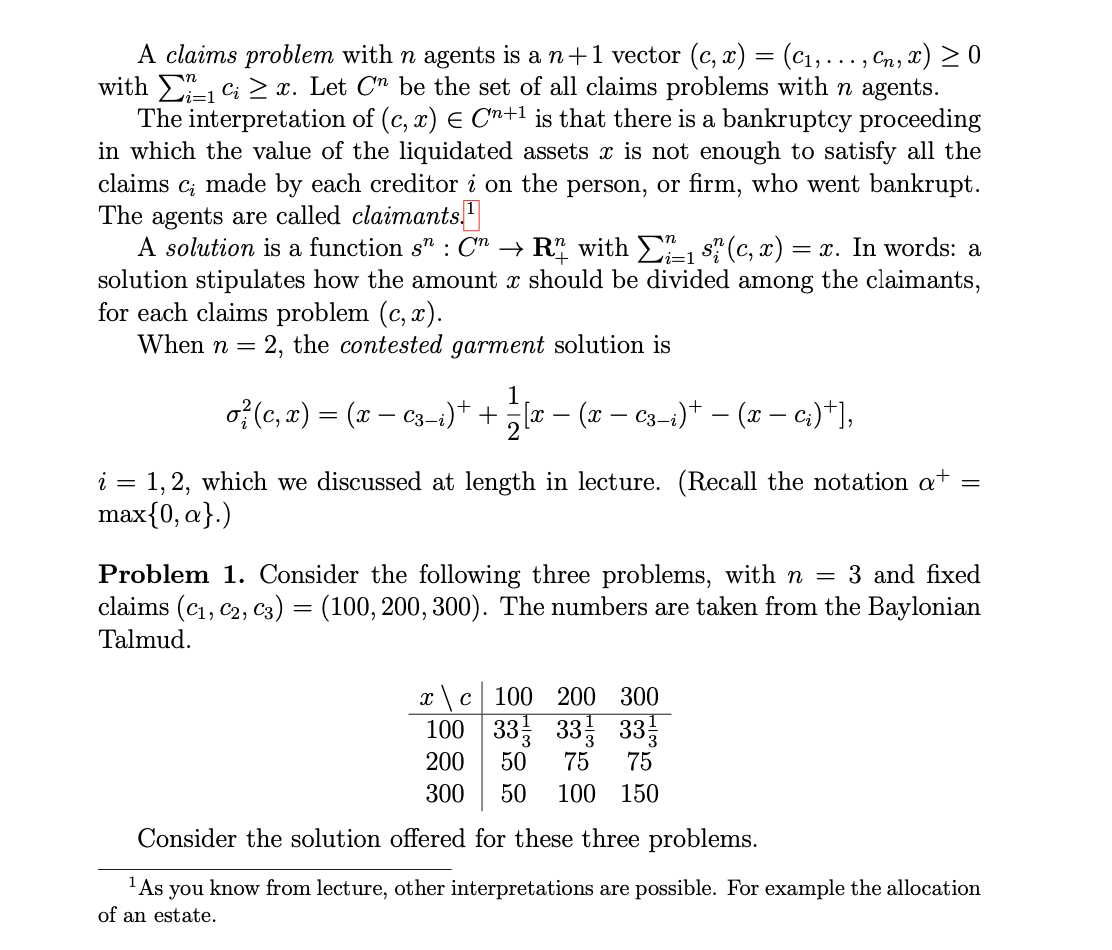
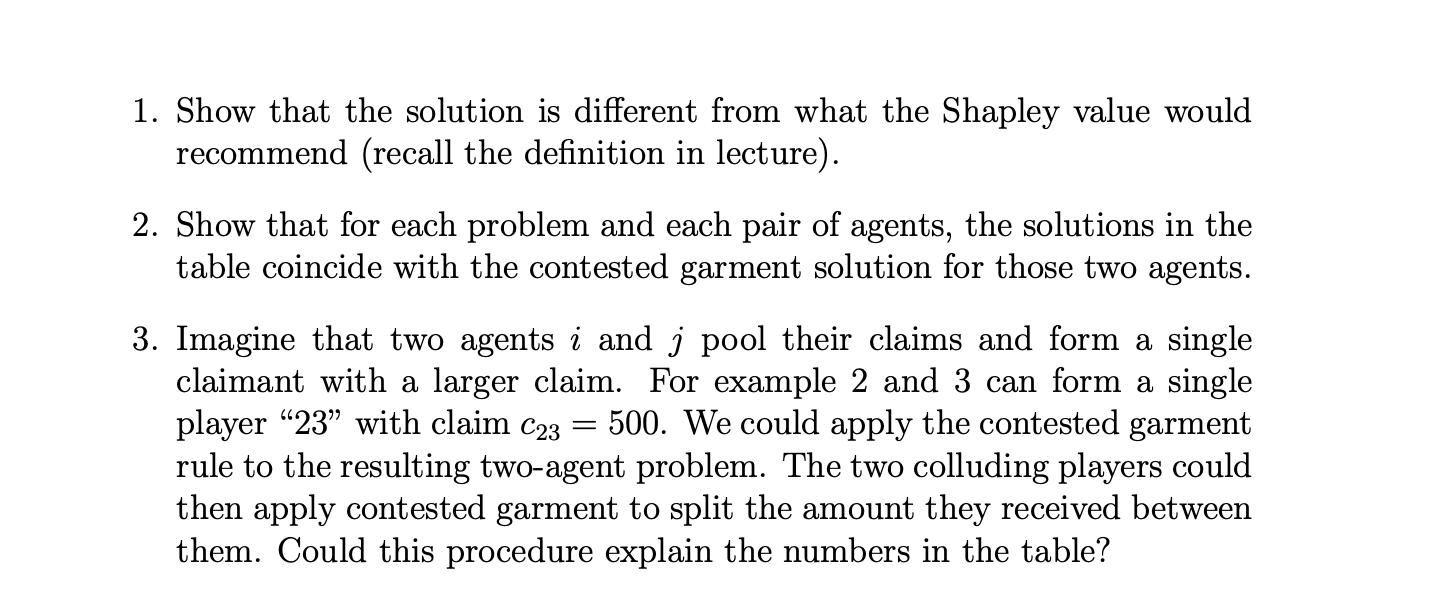
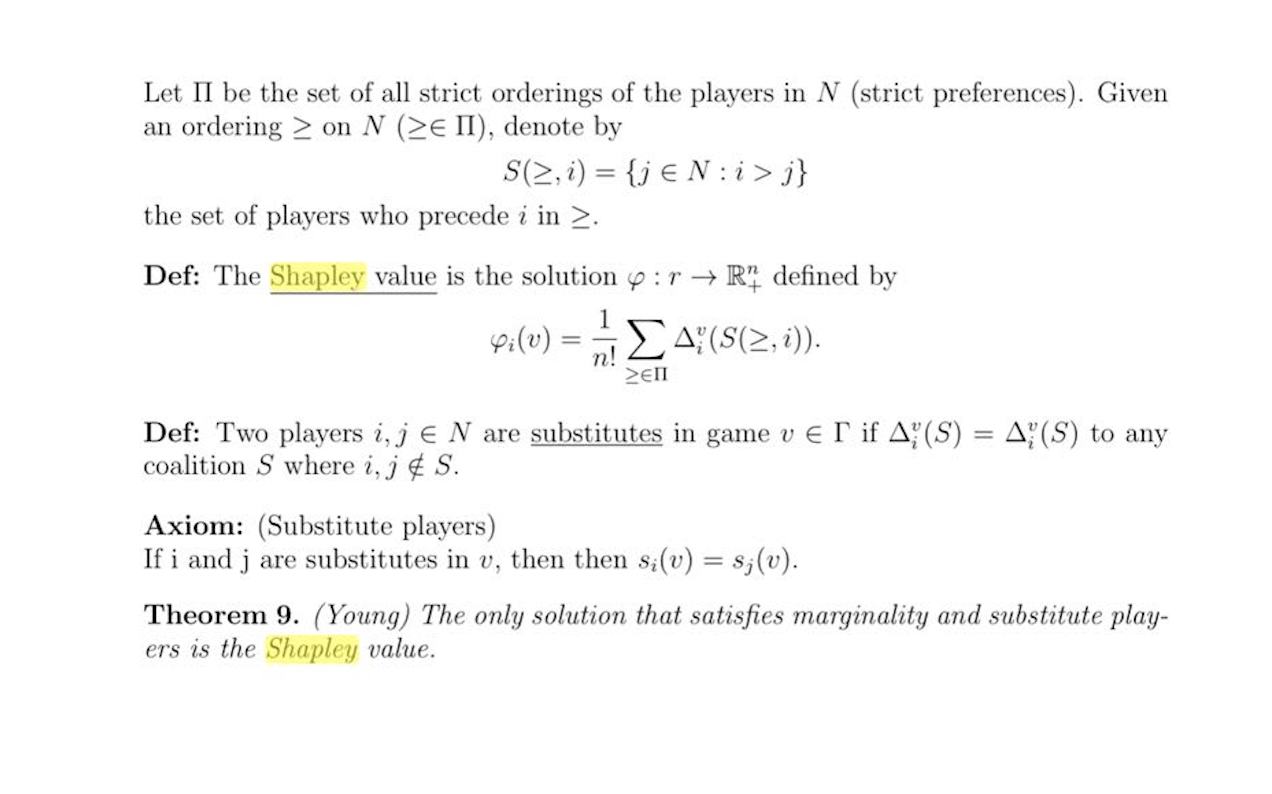
A claims problem with n agents is a n+ 1 vector (, z) = (c1,...,n,2) >0 with " ; > . Let C be the set of all claims problems with n agents. The interpretation of (, z) C*! is that there is a bankruptcy proceeding in which the value of the liquidated assets z is not enough to satisfy all the claims ; made by each creditor on the person, or firm, who went bankrupt. The agents are called claimants!' A solution is a function s : C* R" with )" | s7(c,z) = z. In words: a solution stipulates how the amount z should be divided among the claimants, for each claims problem (c, ). When n = 2, the contested garment solution is oe,7) = (z e3-)" + 5lz (2~ es-0)" (a )], i = 1,2, which we discussed at length in lecture. (Recall the notation a = max{0,a}.) Problem 1. Consider the following three problems, with n = 3 and fixed claims (c1, z, 3) = (100, 200, 300). The numbers are taken from the Baylonian Talmud. z\\ | 100 200 300 100 | 333 331 333 200 | 50 75 75 300 | 50 100 150 Consider the solution offered for these three problems. 1 As you know from lecture, other interpretations are possible. For example the allocation of an estate. 1. Show that the solution is different from what the Shapley value would recommend (recall the definition in lecture). 2. Show that for each problem and each pair of agents, the solutions in the table coincide with the contested garment solution for those two agents. 3. Imagine that two agents and j pool their claims and form a single claimant with a larger claim. For example 2 and 3 can form a single player \"23\" with claim c93 = 500. We could apply the contested garment rule to the resulting two-agent problem. The two colluding players could then apply contested garment to split the amount they received between them. Could this procedure explain the numbers in the table? Let II be the set of all strict orderings of the players in N (strict preferences). Given an ordering > on N (26 II), denote by S(2,i) = {j EN :i> i} the set of players who precede i in 2. Def: The Shapley value is the solution 4 : r -> R" defined by pi (v ) = - A; (S ( 2, 2 )). ZEnI Def: Two players i, j E N are substitutes in game v E I if A; (S) = A; (S) to any coalition S where i, j & S. Axiom: (Substitute players) If i and j are substitutes in v, then then si(v) = s;(v). Theorem 9. (Young) The only solution that satisfies marginality and substitute play- ers is the Shapley value
Step by Step Solution
There are 3 Steps involved in it

Get step-by-step solutions from verified subject matter experts
 Study Help