







Question: A common problem in engineering is how to represent a complicated 3D (or 2D) geometry. This problem arises in 3D printing, image processing, CAD, multiphase
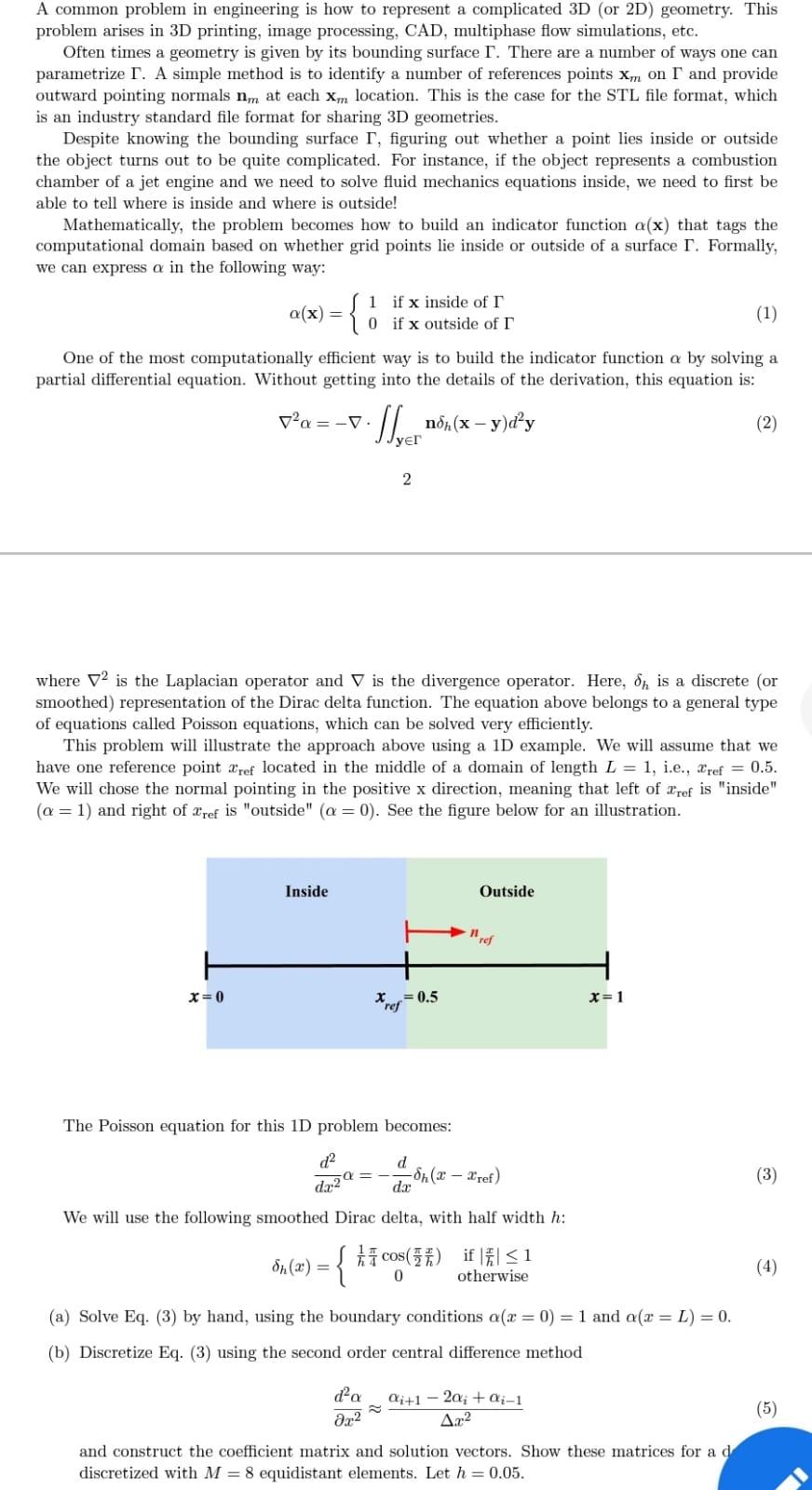
A common problem in engineering is how to represent a complicated 3D (or 2D) geometry. This problem arises in 3D printing, image processing, CAD, multiphase flow simulations, etc. Often times a geometry is given by its bounding surface I'. There are a number of ways one can parametrize I. A simple method is to identify a number of references points Xm on I and provide outward pointing normals nm, at each X, location. This is the case for the STL file format, which is an industry standard file format for sharing 3D geometries. Despite knowing the bounding surface T', figuring out whether a point lies inside or outside the object turns out to be quite complicated. For instance, if the object represents a combustion chamber of a jet engine and we need to solve fluid mechanics equations inside, we need to first be able to tell where is inside and where is outside! Mathematically, the problem becomes how to build an indicator function a(x) that tags the computational domain based on whether grid points lie inside or outside of a surface 1. Formally, we can express a in the following way: a(x) = { 1 if x inside of 1 0 if x outside of (1) One of the most computationally efficient way is to build the indicator function a by solving a partial differential equation. Without getting into the details of the derivation, this equation is: va=-V non(x - y)dy (2) yer 2 where V2 is the Laplacian operator and V is the divergence operator. Here, oh is a discrete (or smoothed) representation of the Dirac delta function. The equation above belongs to a general type of equations called Poisson equations, which can be solved very efficiently. This problem will illustrate the approach above using a 1D example. We will assume that we have one reference point Xref located in the middle of a domain of length L = 1, i.e., Bref = 0.5. We will chose the normal pointing in the positive x direction, meaning that left of Xref is "inside" (a = 1) and right of tref is "outside" (a =0). See the figure below for an illustration. Inside Outside hrer x=0 X= 1 trer=0.5 The Poisson equation for this ID problem becomes: 0h (x A'ref) d dic (3) d229 We will use the following smoothed Dirac delta, with half width h: if
Step by Step Solution
There are 3 Steps involved in it

Get step-by-step solutions from verified subject matter experts
 Study Help