





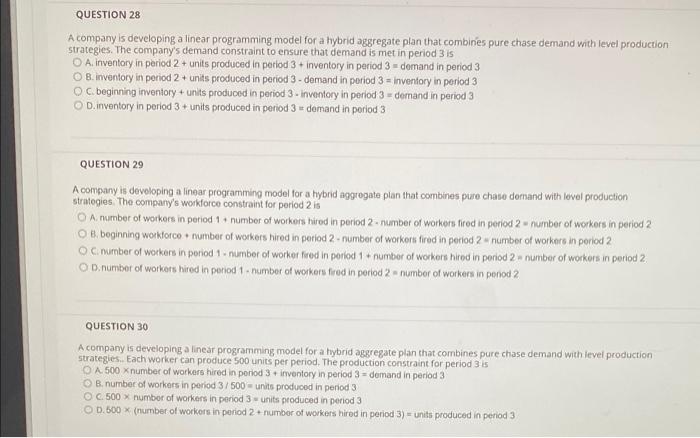
Question: A company is developing a linear programming model for a hybrid aggregate plan that combines pure chase demand with level production strategies. The company's demand
A company is developing a linear programming
A company is developing a linear programming model for a hybrid aggregate plan that combines pure chase demand with level production strategies. The company's demand constraint to ensure that demand is met in period 3 is A. inventory in period 2+ units produced in period 3+ inventory in period 3= domand in period 3 8. inventory in period 2+ units produced in period 3 - demand in period 3= inventory in period 3 C. beginning imventory + units produced in period 3 - inventory in period 3= demand in period 3 D. inventory in period 3+ units produced in period 3= demand in period 3 QUESTION 29 A company is devoloping a linear programming model for a hybrid aggregate plan that combines pure chase dernand with level production strategies. The company's wakforce constraint for period 2 is A. number of workers in period 14 number of workers hired in period 2 - number of workers fired in period 2 = number of workers in period 2 B. beginning wokforce + number of wokkers hired in period 2. number of workers fired in period 2 = number of workers in period 2 C. number of wokkers in period 1- number of worker frod in period 1 + number of workers hired in period 2 number of workers in period 2 . D. number of workers hired in period 1 - number of wokkers fred in period 2 = number of workers in penod 2 QUESTION 30 A company is developing a linear programming model for a hybrid aggregate plan that combines pure chase demand with level production strategies. Each worker can produce 500 units per period. The production constraint for period 3 is A 500 number of workers hired in poriod 3+ irventory in period 3= demand in period 3 B. number of workers in period 3/500= units produced in period 3 C. 500 number of workers in period 3= units produced in period 3 D. 600 (number of workers in period 2+ numbor of wovkers hired in period 3)= units produced in peniod 3 A company is developing a linear programming model for a hybrid aggregate plan that combines pure chase demand with level production strategies. The company's demand constraint to ensure that demand is met in period 3 is A. inventory in period 2+ units produced in period 3+ inventory in period 3= domand in period 3 8. inventory in period 2+ units produced in period 3 - demand in period 3= inventory in period 3 C. beginning imventory + units produced in period 3 - inventory in period 3= demand in period 3 D. inventory in period 3+ units produced in period 3= demand in period 3 QUESTION 29 A company is devoloping a linear programming model for a hybrid aggregate plan that combines pure chase dernand with level production strategies. The company's wakforce constraint for period 2 is A. number of workers in period 14 number of workers hired in period 2 - number of workers fired in period 2 = number of workers in period 2 B. beginning wokforce + number of wokkers hired in period 2. number of workers fired in period 2 = number of workers in period 2 C. number of wokkers in period 1- number of worker frod in period 1 + number of workers hired in period 2 number of workers in period 2 . D. number of workers hired in period 1 - number of wokkers fred in period 2 = number of workers in penod 2 QUESTION 30 A company is developing a linear programming model for a hybrid aggregate plan that combines pure chase demand with level production strategies. Each worker can produce 500 units per period. The production constraint for period 3 is A 500 number of workers hired in poriod 3+ irventory in period 3= demand in period 3 B. number of workers in period 3/500= units produced in period 3 C. 500 number of workers in period 3= units produced in period 3 D. 600 (number of workers in period 2+ numbor of wovkers hired in period 3)= units produced in peniod 3

Step by Step Solution

There are 3 Steps involved in it

1 Expert Approved Answer
Step: 1 Unlock blur-text-image

Question Has Been Solved by an Expert!

Get step-by-step solutions from verified subject matter experts

Step: 2 Unlock
Step: 3 Unlock

Students Have Also Explored These Related General Management Questions!