







Question: A competitive software rm has a production function f(:s1, $2) = 2% where :52 is the number of computers and 3:1 is number of workers
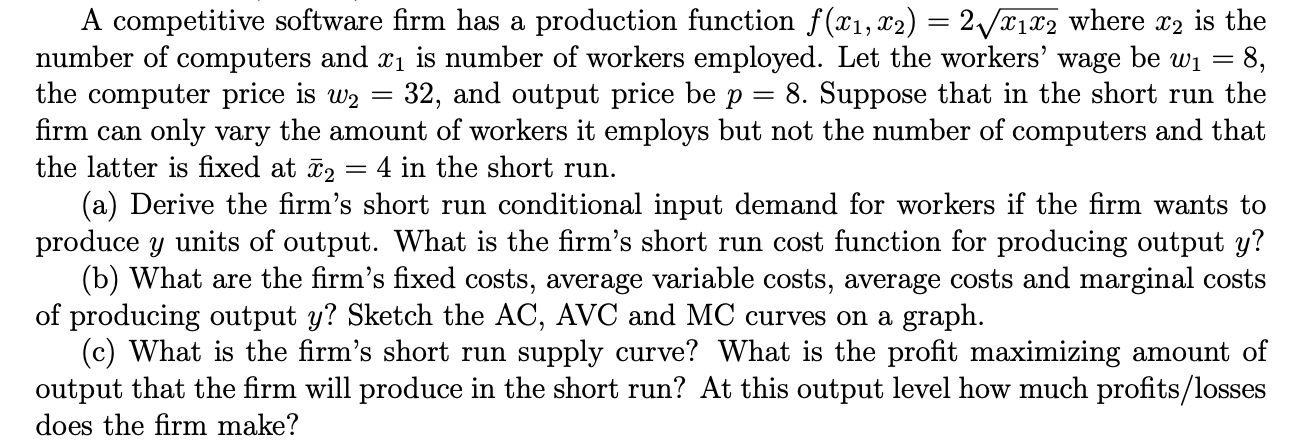

A competitive software rm has a production function f(:s1, $2) = 2% where :52 is the number of computers and 3:1 is number of workers employed. Let the workers' wage be wl = 8, the computer price is 102 = 32, and output price be p = 8. Suppose that in the short run the rm can only vary the amount of workers it employs but not the number of computers and that the latter is xed at 532 = 4 in the short run. (a) Derive the rm's short run conditional input demand for workers if the rm wants to produce 3; units of output. What is the rm's short run cost function for producing output 3;? (b) What are the rm's xed costs, average variable costs, average costs and marginal costs of producing output y? Sketch the AC, AVC and MC curves on a graph. (c) What is the rm's short run supply curve? What is the prot maximizing amount of output that the rm will produce in the short run? At this output level how much prots / losses does the rm make? (d) What are the rm's long run conditional input demands for producing 3; units of output? What is its long run cost function? What is its long run supply curve? (Hint: You can use the condition for optimum TRS = $42 to solve the rm's cost minimization problem) (e) Assuming that input and output prices remain at their given short run levels in the long run as well, how much would the rm produce in the long run
Step by Step Solution
There are 3 Steps involved in it

Get step-by-step solutions from verified subject matter experts
 Study Help