







Question: (a) compute the return on assets (ROA) and return on equity (ROE) for 2016 (8 points) (b) Complete the DuPont disaggregation of return on equity
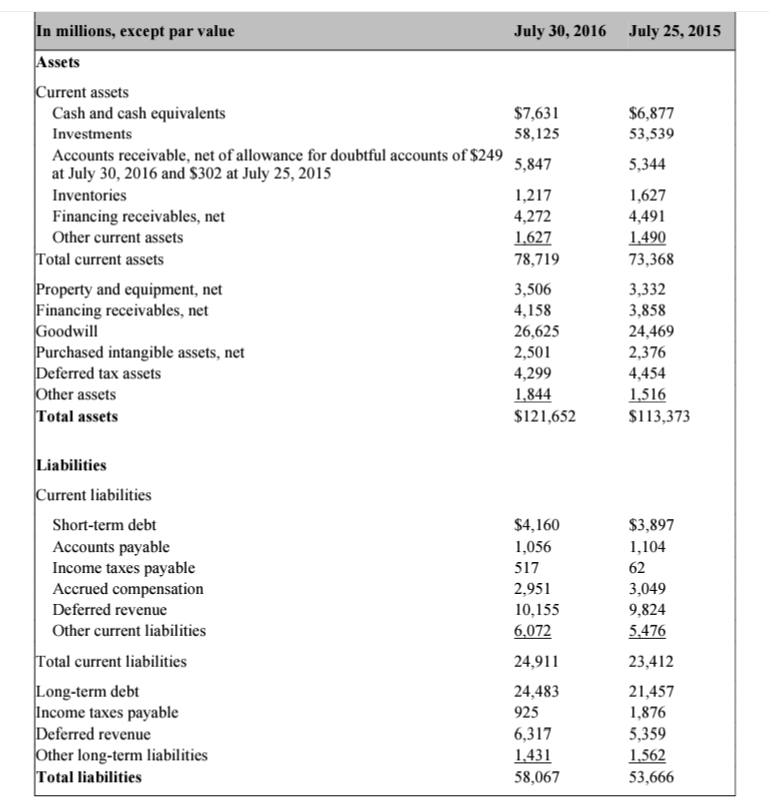
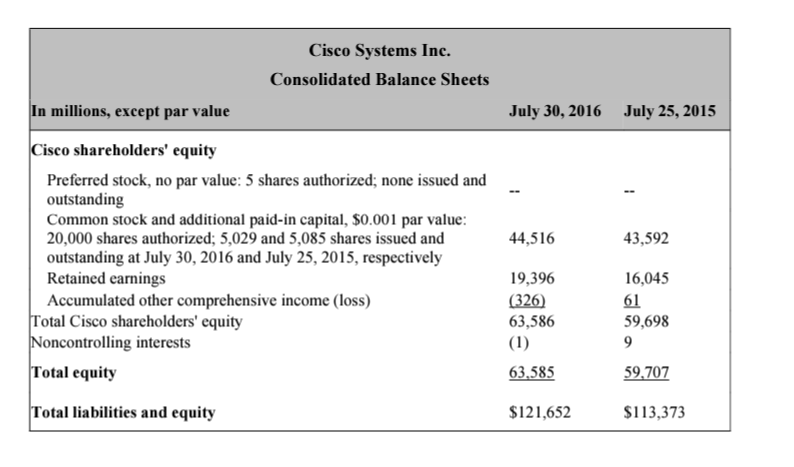
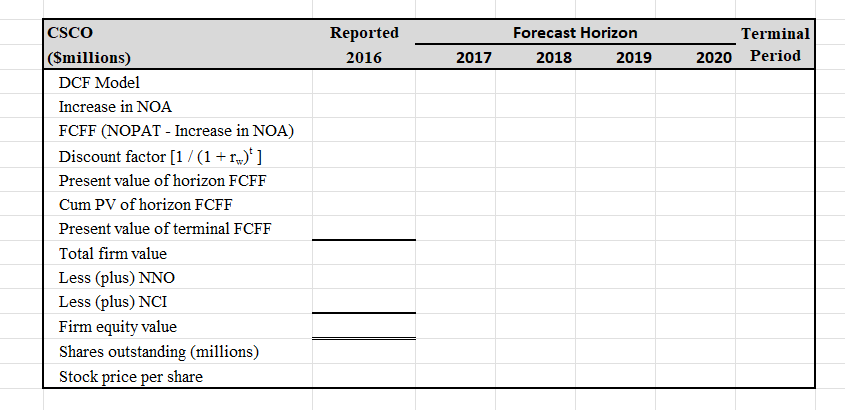
(a) compute the return on assets (ROA) and return on equity (ROE) for 2016 (8 points) (b) Complete the DuPont disaggregation of return on equity (ROE) for 2016. Analyze the DuPont financial ratios and discuss how Cisco Systems Inc. can achieve a high ROE. (12 points) (c) Compute net operating assets (NOA) for 2016. Note, for the balance sheet items of Cisco Systems, non-operating assets include cash and cash equivalents, and investments. Nonoperating liabilities include short-term debt and long-term debt. (6 points) (d) Compute net operating profit after tax (NOPAT) for 2016, assuming a federal and state statutory tax rate of 37%. (Round your answer to the nearest whole number.) (9 points) (e) Forecast Cisco's sales, NOPAT, and NOA for years 2017 through 2020 and the terminal period using the following assumptions: (12 points) Sales growth 2017 8% Sales growth 2018 8% Sales growth 2019 5% Sales growth 2020 3% Terminal growth 2% Net operating profit margin 2016 rate rounded to three decimal places Net operating asset turnover 2016 rate rounded to three decimal places Assume a discount rate (WACC) of 10%, common shares outstanding of 5,029 million, and net nonoperating obligations (NNO) of $(37,113) million (NNO is negative which means that Cisco has net nonoperating investments). (f) Estimate the value of a share of Cisco common stock as of July 30, 2016 using the discounted cash flow (DCF) model and sales, NOPAT and NOA forecast in (e); Describe the DCF model, and explain the computations and results. (15 points) 6 (g) Cisco stock closed at $31.47 on September 8, 2016, the date the Form 10-K was filed with the SEC. How does your DCF valuation estimates compare with this closing price? What do you believe are some reasons for the difference? What investment decision is suggested from your results? (8 points) (h) Assume that Ciscos weighted average cost of capital (WACC) increased to 15% due to the high inflation. Estimate the value of a share of Cisco common stock as of July 30, 2016, using the discounted cash flow (DCF) model and the forecast in (e); Describe the computations, and discuss how the increase in WACC affects Ciscos stock price. (10 points) Note, still assume common shares outstanding of 5,029 million, and net nonoperating obligations (NNO) of $(37,113) million. (i) Discuss how inflation, federal monetary policy, credit ratings, and sales growth opportunities affect Ciscos equity valuation based on the DCF and CAPM models. (8 points) (j) Are there other equity valuation models? Please discuss the advantages and disadvantages of different equity valuation models. (12 points)
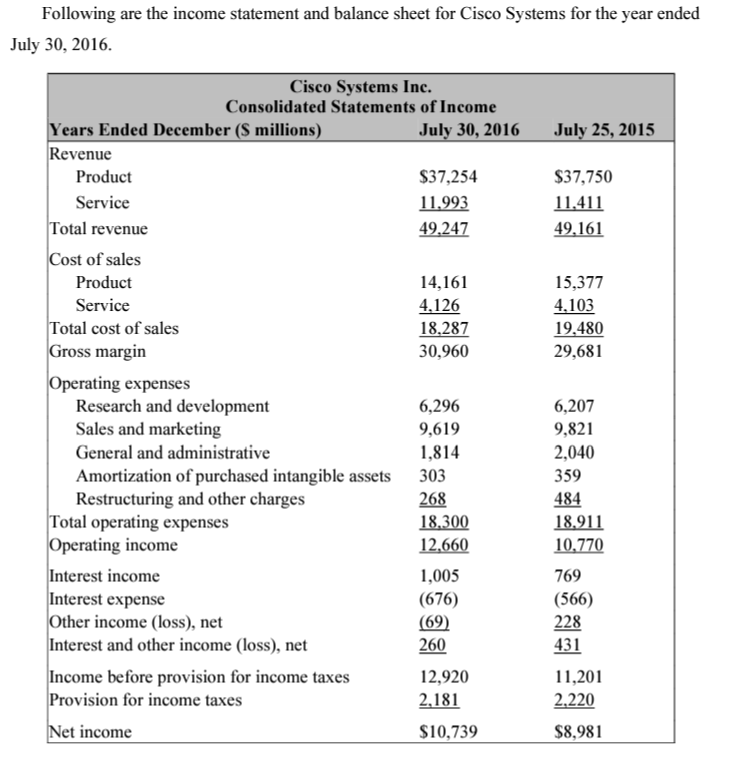
Following are the income statement and balance sheet for Cisco Systems for the year ended
Step by Step Solution
There are 3 Steps involved in it

Get step-by-step solutions from verified subject matter experts
 Study Help