Question: A computer software firm was interested in studying the difficulties encountered in forecasting the programmer requirements for large-scale programming projects. 24 programmers, classified into equal
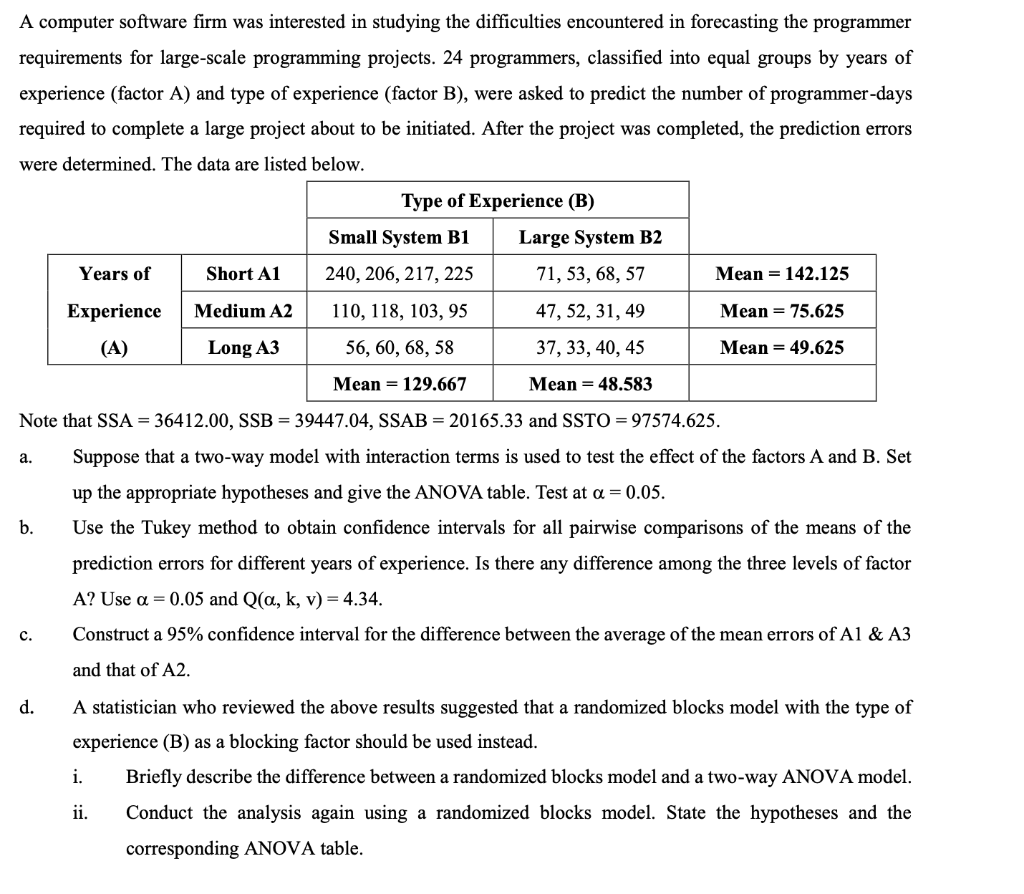
A computer software firm was interested in studying the difficulties encountered in forecasting the programmer requirements for large-scale programming projects. 24 programmers, classified into equal groups by years of experience (factor A) and type of experience (factor B), were asked to predict the number of programmer-days required to complete a large project about to be initiated. After the project was completed, the prediction errors were determined. The data are listed below. Years of Short A1 Type of Experience (B) Small System B1 Large System B2 240, 206, 217, 225 71, 53, 68, 57 110, 118, 103,95 47, 52, 31, 49 56, 60, 68, 58 37, 33, 40, 45 Mean = 142.125 Experience Medium A2 Mean = 75.625 (A) Long A3 Mean = 49.625 Mean = 129.667 Mean = 48.583 a. Note that SSA = 36412.00, SSB = 39447.04, SSAB = 20165.33 and SSTO = 97574.625. Suppose that a two-way model with interaction terms is used to test the effect of the factors A and B. Set up the appropriate hypotheses and give the ANOVA table. Test at a = 0.05. b. Use the Tukey method to obtain confidence intervals for all pairwise comparisons of the means of the prediction errors for different years of experience. Is there any difference among the three levels of factor A? Use a = 0.05 and Qla, k, v) = 4.34. Construct a 95% confidence interval for the difference between the average of the mean errors of Al & A3 and that of A2. c. d. A statistician who reviewed the above results suggested that a randomized blocks model with the type of experience (B) as a blocking factor should be used instead. i. Briefly describe the difference between a randomized blocks model and a two-way ANOVA model. ii. Conduct the analysis again using a randomized blocks model. State the hypotheses and the corresponding ANOVA table. A computer software firm was interested in studying the difficulties encountered in forecasting the programmer requirements for large-scale programming projects. 24 programmers, classified into equal groups by years of experience (factor A) and type of experience (factor B), were asked to predict the number of programmer-days required to complete a large project about to be initiated. After the project was completed, the prediction errors were determined. The data are listed below. Years of Short A1 Type of Experience (B) Small System B1 Large System B2 240, 206, 217, 225 71, 53, 68, 57 110, 118, 103,95 47, 52, 31, 49 56, 60, 68, 58 37, 33, 40, 45 Mean = 142.125 Experience Medium A2 Mean = 75.625 (A) Long A3 Mean = 49.625 Mean = 129.667 Mean = 48.583 a. Note that SSA = 36412.00, SSB = 39447.04, SSAB = 20165.33 and SSTO = 97574.625. Suppose that a two-way model with interaction terms is used to test the effect of the factors A and B. Set up the appropriate hypotheses and give the ANOVA table. Test at a = 0.05. b. Use the Tukey method to obtain confidence intervals for all pairwise comparisons of the means of the prediction errors for different years of experience. Is there any difference among the three levels of factor A? Use a = 0.05 and Qla, k, v) = 4.34. Construct a 95% confidence interval for the difference between the average of the mean errors of Al & A3 and that of A2. c. d. A statistician who reviewed the above results suggested that a randomized blocks model with the type of experience (B) as a blocking factor should be used instead. i. Briefly describe the difference between a randomized blocks model and a two-way ANOVA model. ii. Conduct the analysis again using a randomized blocks model. State the hypotheses and the corresponding ANOVA table









 Study Help