







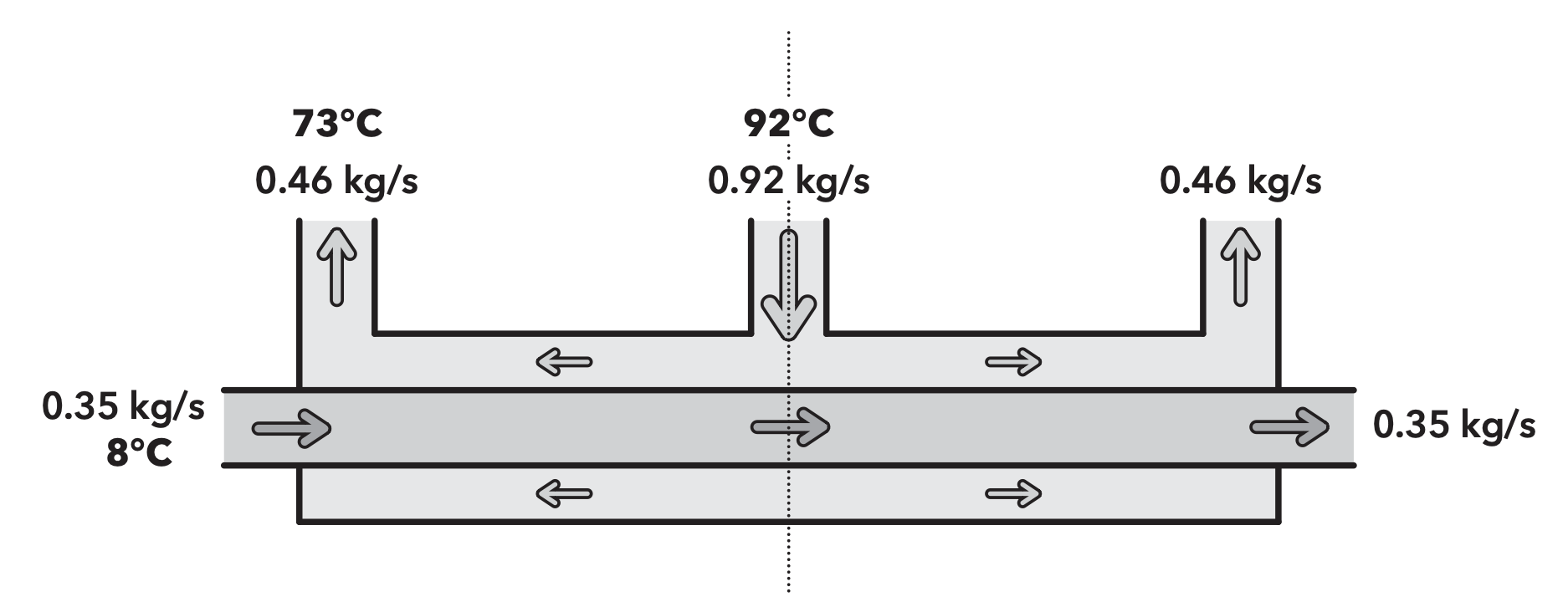
Question: A concentric tube ( parallel flow ) heat exchanger is built and operated as shown in the illustration be - low. e purpose of the
A concentric tube parallel flow heat exchanger is built and operated as shown in the illustration be
low. e purpose of the heat exchanger is to use heat from a hotwater waste stream to heat a stream
of cold water from the municipal supply. e cold tubeside flow kgs passes through the entire
heat exchanger, while the hot shellside flow kgs enters at the middle and splits evenly
kgs in each directione two halves of the heat exchanger are identical, except for the flow
direction on the shell side.
e cold inlet temperature is C and the hot inlet temperature is Ce hot outlet temperature
from the side with countercurrent flow is C Use the heat capacity at the average of the hot inlet
and cold inlet temperatures throughout your calculations, for both the hot and coldsides.
a Determine the coldside temperature at the midpoint in the tube, by considering only the coun
tercurrent side of the heat exchanger. Determine the logmean temperature dierence on that side
and estimate the overall heat transfer coecient for that side of the heat exchanger.
b Explain why you expect that the overall heat transfer coecient for the other half of the heat ex
changer will almost identical to the value above. en explain separately why the overall heat
transfer coecient for the other half of the heat exchanger will be very slightly dierent
c Assuming that the overall heat transfer coecients are the same for both sides of the heat ex
changer, estimate the outlet temperatures from the other half of the heat exchanger using the
NTU method on the second half of the heat exchanger
d An outlet cold temperature of C is desired, which can be achieved by altering the rightle
split of flow on the hot side. Consider the worst case for heat exchange with the same total flow
rates and inlet temperatures. Assuming that the overall heat transfer coecient for each half does
not change: what is the minimum coldside outlet temperature that can be achieved with such an
approach? Hint: using the NTU method again is the easiest approach.
Step by Step Solution
There are 3 Steps involved in it
1 Expert Approved Answer
Step: 1 Unlock

Question Has Been Solved by an Expert!
Get step-by-step solutions from verified subject matter experts
Step: 2 Unlock
Step: 3 Unlock
 Study Help