







Question: a. Concept definition b. Hypothesis CI Problem statement d. Research question . Which of the following is not a type of nonrandom sampling? a. Cluster
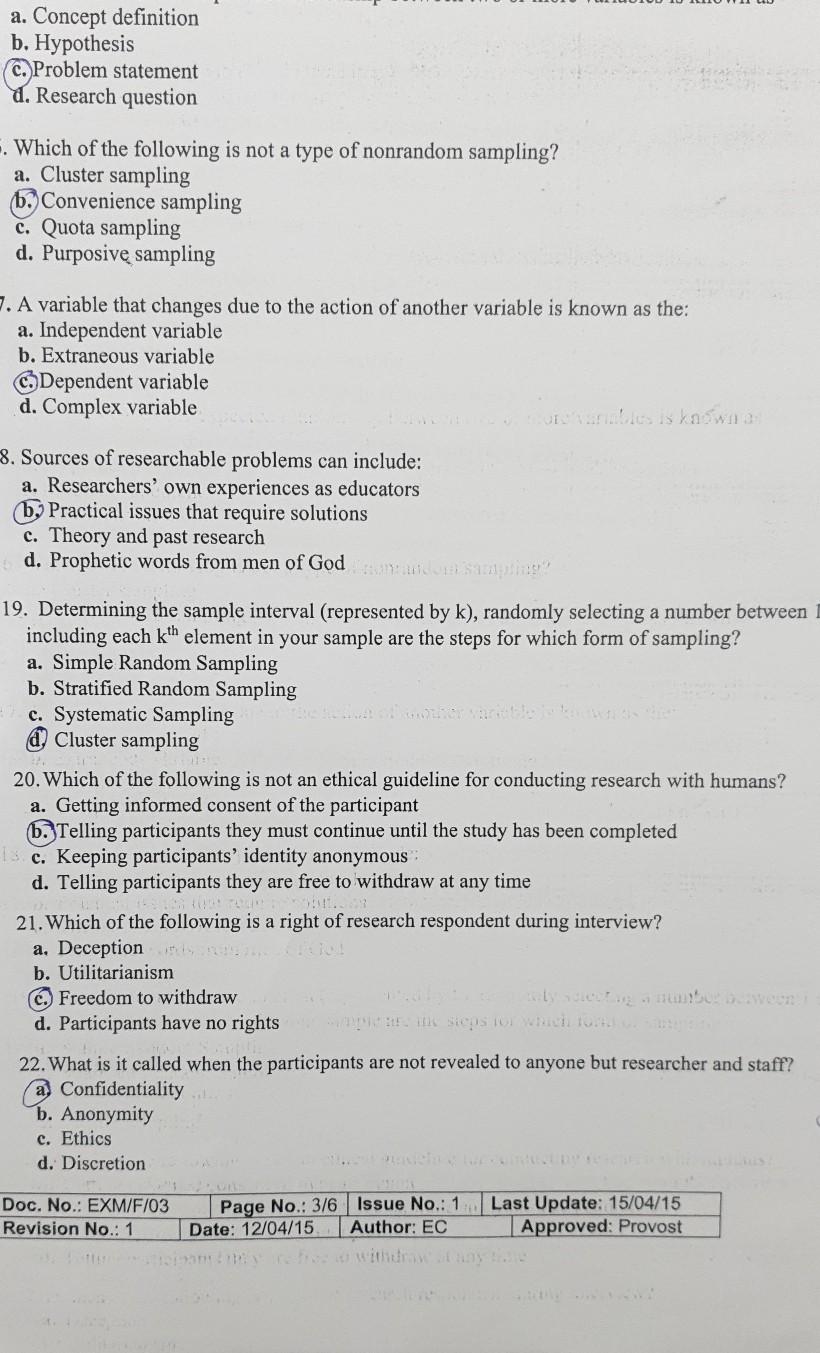

a. Concept definition b. Hypothesis CI Problem statement d. Research question . Which of the following is not a type of nonrandom sampling? a. Cluster sampling b. Convenience sampling c. Quota sampling d. Purposive sampling 7. A variable that changes due to the action of another variable is known as the: a. Independent variable b. Extraneous variable Dependent variable d. Complex variable I bas is known 8. Sources of researchable problems can include: a. Researchers' own experiences as educators b) Practical issues that require solutions c. Theory and past research d. Prophetic words from men of God 19. Determining the sample interval (represented by k), randomly selecting a number between including each kth element in your sample are the steps for which form of sampling? a. Simple Random Sampling b. Stratified Random Sampling c. Systematic Sampling d. Cluster sampling 20. Which of the following is not an ethical guideline for conducting research with humans? a. Getting informed consent of the participant b. Telling participants they must continue until the study has been completed c. Keeping participants' identity anonymous d. Telling participants they are free to withdraw at any time 21. Which of the following is a right of research respondent during interview? a. Deception, ON b. Utilitarianism c. Freedom to withdraw d. Participants have no rights 22. What is it called when the participants are not revealed to anyone but researcher and staff? a Confidentiality b. Anonymity e. Ethics d. Discretion Doc. No.: EXM/F/03 Revision No.: 1 Page No.: 3/6 Issue No.: 1 Last Update: 15/04/15 Date: 12/04/15 Author: EC Approved: Provost 23. Which of the following is non-probability sampling? a. Snowball b. Systematic c. Cluster d. Stratified 24. Which of the following are examples of 'secondary sources of data? a. Interviews and diaries b. Personal documents and story completion tasks c. Diaries and surveys d. Personal documents and the media 25. Editing a draft of your report: a. Is only important if you have used discourse analysis b> is only necessary to correct typos c. Is an important part of good academic writing d. Is only necessary when you are not happy with what you have written 26. All of the following are advantages of personal interviews EXCEPT: a. There is a high response rate b. The researcher can ensure that the questions are answered in the correct order C.The researcher can answer questions for the respondents d. Data collection is usually very fast compared to other methods 27. The complete set of individuals we wish to examine is called the a. Sample b. Stratified sample c. Random sample d. Population c. 28. Which of the following does not correspond to characteristics of research? a. Research is not passive b. Research is systematic wavulave written Research is not a problem-oriented d. Research is not a process 29. Which of the following processes is not needed in experimental rese research? a Controlling Sa uns With COTTOCE Ordici b. Observation c. Reference collection d. Manipulation and replication 30. Which one among the following phrases does not correspond to the meaning of research as a process? a. Problem Solving (6.) Trial and Error c. Objective Observation d. Systematic Activity Doc. No.: EXM/F/03 Revision No.: 1 Page No.: 4/6 Issue No.: 1 Date: 12/04/15 Author: EC Last Update: 15/04/15 Approved: Provost edit
Step by Step Solution
There are 3 Steps involved in it
1 Expert Approved Answer
Step: 1 Unlock

Question Has Been Solved by an Expert!
Get step-by-step solutions from verified subject matter experts
Step: 2 Unlock
Step: 3 Unlock
 Study Help