







Question: A concrete column with dimensions shown below. The column must support the load in lbs . noted on the drawing below. If you plan to
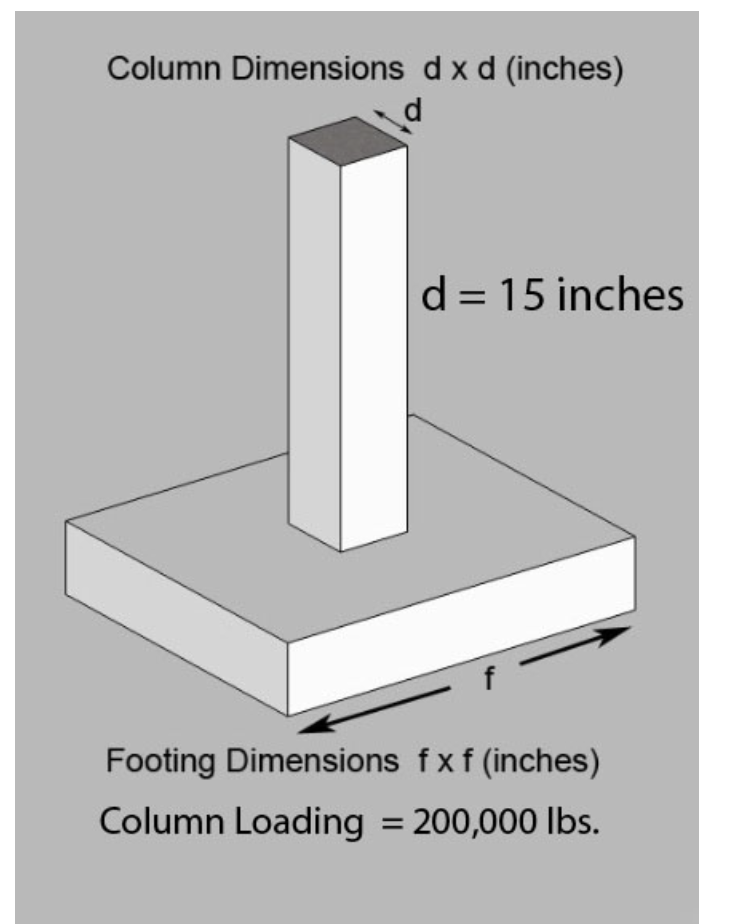
A concrete column with dimensions shown below. The column must support the load in lbs noted on the drawing below. If you plan to support this column with a square concrete footing resting on soil that can resist lbsq inch including an appropriate safety factor what is the dimension of the footing finches Calculate the dimension f to the nearest inch see the figure belowIf your calculated answer is inches enter If you are within of the correct answer you well receive full credit.Bonus Question Column Dimensions dx d inches
Footing Dimensions fxf inches
Column Loading lbs
the size of the foundation footing to the crosssectional area of the column. In engineering design, an appropriate safety factor, typically is included in our calculation to insure against the unforeseen. Soils, unlike manufactured and engineered materials, are hardly homogenous in nature. In foundation design, safety factors can be several multiples. In our example, we will require a crosssectional area of mathrmsq inches of surface to distribute the column loading of mathrmlbs In this example, a column footing of times inches should be adequate. The engineering solution is to provide a mechanism for distributing our load over a greater area. In the past, a pyramid form was used to distribute this load Figure During the th century, rafts made from used railroad ties buried in concrete were used to distribute the column loading; today, we can use reinforced concrete to solve this problem. Formwork, with carefully placed steel reinforcing bars, creates an homogeneous and continuous structure that transmits the column loads to the bearing material just below the foundation Figure
Continuous footings can also be used to support an entire bearing wall. Usually found at the perimeter of the basement wall, a continuous footing has a crosssection similar to the reinforced concrete footing Figure Spread footings are useful when the bearing wall supports a significant portion of the weight from the floors and roof structure. When Foundation design
The simplest of foundations are spread footings. Used for centuries, spread footings take the loading from the columns and distribute it over a larger surface area Figure In this way, the foundation does not overburden the substrate beyond its bearing capacity or safe limit For example, a building with column loads at the foundation of kips equivalent to mathrmlbs may be easily handled by a concrete column measuring times inches a crosssectional area of sq inches With a working stress level of approximately mathrmpsi there is a significant safety factor designed into these columns. However, if the soil substructure is able to support a maximum of only psi including an appropriate safety factor a column placed directly on the soil will exceed its safe limit and we can expect the building to settle or possibly collapse over time. To solve this problem, we will need to spread this load over a greater area. In this case, we need at least a ratio of : in
Step by Step Solution
There are 3 Steps involved in it
1 Expert Approved Answer
Step: 1 Unlock

Question Has Been Solved by an Expert!
Get step-by-step solutions from verified subject matter experts
Step: 2 Unlock
Step: 3 Unlock
 Study Help