





Question: A Consensus Feasibility Study for Montreal's Archipel Dam Project Management in Practice: A Consensus Feasibility Study for Montreal's Archipel Dam Please provide an initial response
A Consensus Feasibility Study for Montreal's
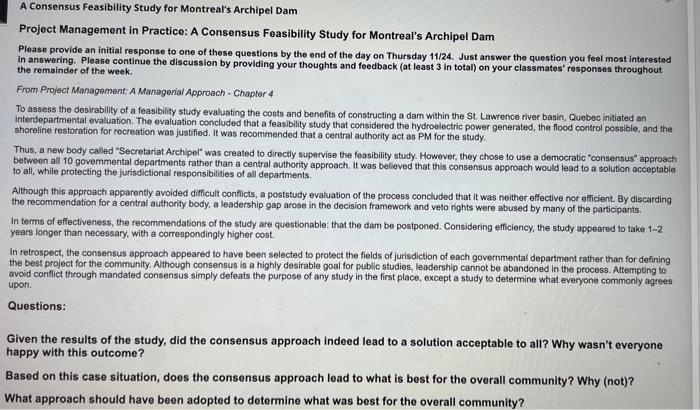
A Consensus Feasibility Study for Montreal's Archipel Dam Project Management in Practice: A Consensus Feasibility Study for Montreal's Archipel Dam Please provide an initial response to one of these questions by the end of the day on Thursday 11/24. Just answer the question you feel most interested in answering. Please continue the discussion by providing your thoughts and feedback (at least 3 in total) on your classmates' responses throughout the remainder of the week. From Project Management: A Managenial Approach - Chapter 4 To assess the desirability of a feasibility study evaluating the costs and benefits of constructing a dam within the St. Lawrence river basin, Quebec initiated an interdepartmental evaluation. The evaluation concluded that a feasibility study that considered the hydroelectric power generated, the flood control possible, and the shoreline restoration for recreation was justified. It was recommended that a central authority act as PM for the study. Thus, a new body called "Secretariat Archipel" was created to directly supervise the feasibility study. However, they chose to use a democratic "consensus" approach betwoen all 10 govemmental departments rather than a central authority approach. It was believed that this consensus approach would lead to a solution acceptable to all, while protecting the jurisdictional responsibilities of all departments. Although this approach apparently avoided difficult conflicts, a poststudy evaluation of the process concluded that it was neither effective nor efficient. By discarding the recommendation for a central authority body, a leadership gap arose in the decision framework and veto rights were abused by many of the participants. In terms of effectiveness, the recommendations of the study are questionable: that the dam be postponed. Considering efficiency, the study appeared to take 12 years longer than necessary. with a correspondingly higher cost. In retrospect, the consensus approach appeared to have been selected to protect the fields of jurisdiction of each governmental department rather than for defining the best project for the community. Although consensus is a highly desirable goal for public studies, leadership cannot be abandoned in the process. Attempting to avoid conflict through mandated consensus simply defeats the purpose of any study in the first place, except a study to determine what everyone commonly agrees upon. Questions: Given the results of the study, did the consensus approach indeed lead to a solution acceptable to all? Why wasn't everyone happy with this outcome? Based on this case situation, does the consensus approach lead to what is best for the overall community? Why (not)? What approach should have been adopted to determine what was best for the overall community

Step by Step Solution

There are 3 Steps involved in it

1 Expert Approved Answer
Step: 1 Unlock blur-text-image

Question Has Been Solved by an Expert!

Get step-by-step solutions from verified subject matter experts

Step: 2 Unlock
Step: 3 Unlock

Students Have Also Explored These Related General Management Questions!