







Question: a) Consider a binary program with n variables and m constraints. What is the maximum number of linear programs that you might need to
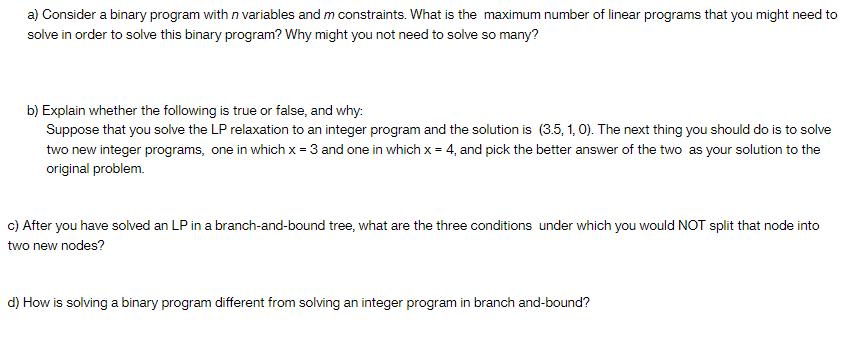
a) Consider a binary program with n variables and m constraints. What is the maximum number of linear programs that you might need to solve in order to solve this binary program? Why might you not need to solve so many? b) Explain whether the following is true or false, and why: Suppose that you solve the LP relaxation to an integer program and the solution is (3.5, 1, 0). The next thing you should do is to solve two new integer programs, one in which x = 3 and one in which x = 4, and pick the better answer of the two as your solution to the original problem. c) After you have solved an LP in a branch-and-bound tree, what are the three conditions under which you would NOT split that node into two new nodes? d) How is solving a binary program different from solving an integer program in branch and-bound?
Step by Step Solution
There are 3 Steps involved in it
a The maximum number of linear programs needed to solve a binary program with n variables and m cons... View full answer

Get step-by-step solutions from verified subject matter experts
 Study Help