







Question: A consumer is making saving plans for this year and the next. She knows for sure that her real income after taxes will be $0
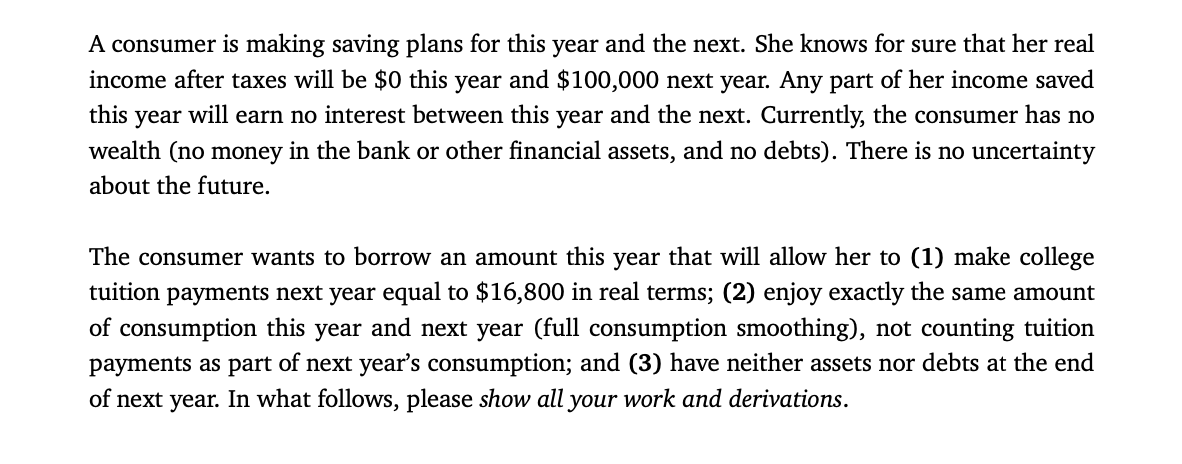
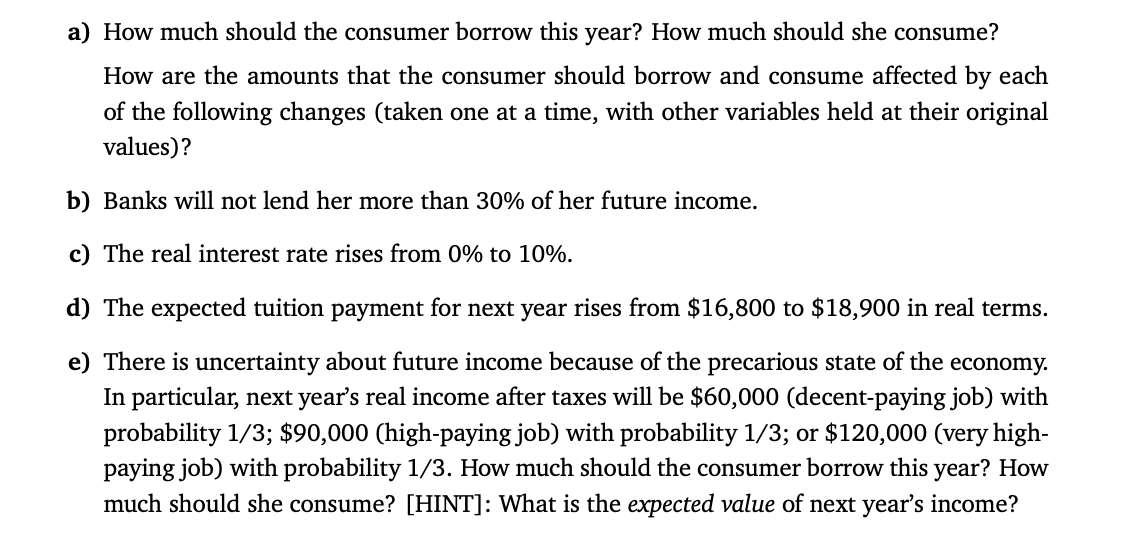
A consumer is making saving plans for this year and the next. She knows for sure that her real income after taxes will be $0 this year and $100,000 next year. Any part of her income saved this year will earn no interest between this year and the next. Currently, the consumer has no wealth (no money in the bank or other nancial assets, and no debts). There is no uncertainty about the future. The consumer wants to borrow an amount this year that will allow her to (1) make college tuition payments next year equal to $16,800 in real terms; (2) enjoy exactly the same amount of consumption this year and next year (full consumption smoothing), not counting tuition payments as part of next year's consumption; and (3) have neither assets nor debts at the end of next year. In what follows, please show all your work and derivations. a) How much should the consumer borrow this year? How much should she consume? How are the amounts that the consumer should borrow and consume affected by each of the following changes (taken one at a time, with other variables held at their original values)? b) Banks will not lend her more than 30% of her future income. c) The real interest rate rises from 0% to 10%. d) The expected tuition payment for next year rises from $16,800 to $18,900 in real terms. 9.) There is uncertainty about future income because of the precarious state of the economy. In particular, next year's real income after taxes will be $60,000 (decent-paying job) with probability 1/ 3; $90,000 (high-paying job) with probability 1/3; or $120,000 (very high- paying job) with probability 1/3. How much should the consumer borrow this year? How much should she consume? [HINT]: What is the expected value of next year's income
Step by Step Solution
There are 3 Steps involved in it

Get step-by-step solutions from verified subject matter experts
 Study Help