







Question: A continuous random variable X is said to have an exponential distribution, written Exp(X), if its probability density function f is such that f(x)=
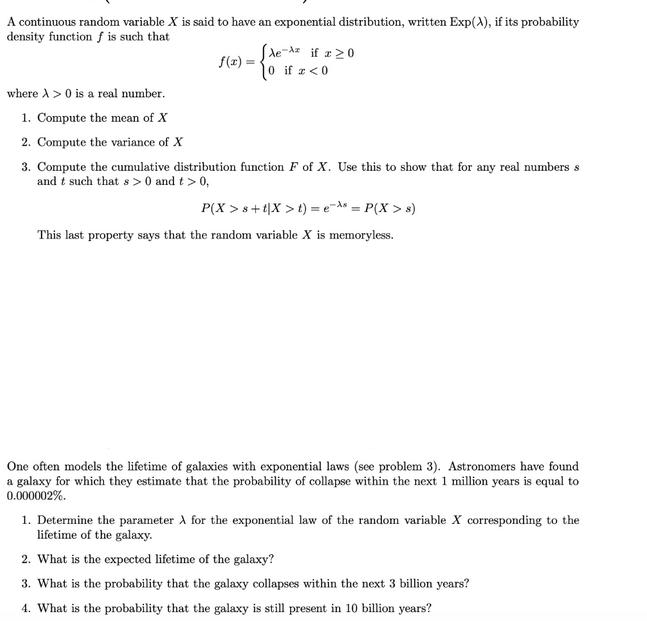
A continuous random variable X is said to have an exponential distribution, written Exp(X), if its probability density function f is such that f(x)= xe-Az if z 20 0 if z 0 is a real number. 1. Compute the mean of X 2. Compute the variance of X 3. Compute the cumulative distribution function F of X. Use this to show that for any real numbers s and t such that s> 0 and t > 0, P(X>s+t| X >t) = e-** = P(x > s) This last property says that the random variable X is memoryless. One often models the lifetime of galaxies with exponential laws (see problem 3). Astronomers have found a galaxy for which they estimate that the probability of collapse within the next 1 million years is equal to 0.000002%. 1. Determine the parameter for the exponential law of the random variable X corresponding to the lifetime of the galaxy. 2. What is the expected lifetime of the galaxy? 3. What is the probability that the galaxy collapses within the next 3 billion years? 4. What is the probability that the galaxy is still present in 10 billion years?
Step by Step Solution
3.46 Rating (156 Votes )
There are 3 Steps involved in it
fx ex Moment Generating Function 1 Mxt Ee tx e tx fx ... View full answer

Get step-by-step solutions from verified subject matter experts
 Study Help