Question: A court can only hear a case over which it has jurisdiction. Jurisdiction is the authority of a court to hear and determine disputes. Jurisdiction
A court can only hear a case over which it has jurisdiction. Jurisdiction is the authority of a court to hear and determine disputes. Jurisdiction can be limited in several ways. Some courts are limited by subject matter jurisdiction. They can hear only cases involving certain types of controversies, such as tax disputes or juvenile matters. Other courts are limited by the amount of damages being sought or the penalty to be assessed. The small claims courts discussed later in this chapter are limited by such jurisdiction. The jurisdiction of all courts is limited geographically. A court may not decide a legal dispute unless it has personal jurisdiction over the defendant. Personal jurisdiction generally does not exist unless the defendant has some close connection with the territory where the suit is brought. HYPOTHETICAL: Connie, a resident of Michigan, was visiting her grandmother in California. While dining at a restaurant, a light fixture fell and severely cut Connie's arm. Connie required surgery and several months of physical therapy before she was able to use her arm properly, and she still has residual damage. She sues the restaurant, asking for $500,000 to reimburse medical expenses, lost wages, and the permanent damage, and $500,000 for pain and suffering.
QUESTION: Where can the lawsuit be heard, and why? (HINT: See Page 31 of Law for Business (Barnes, 2012)). Page 31 included. Please clearly answer this question on where the lawsuit can be heard.
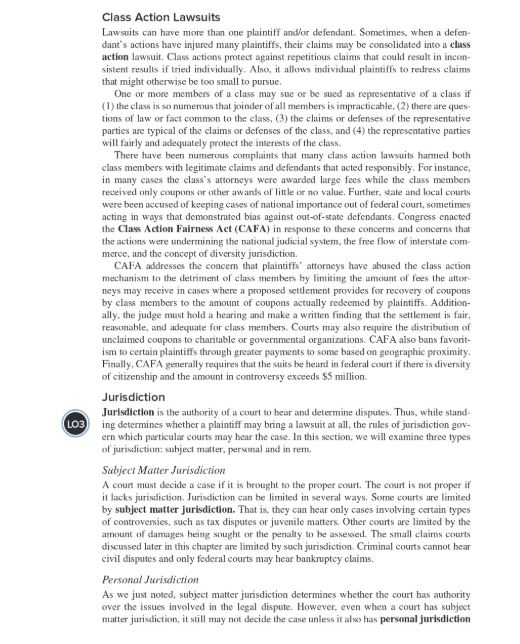
Class Action Lawsuits Lawsuits can have more than one plaintiff and/or defendant. Sometimes, when a defen- dant's actions have injured many plaintiffs, their claims may be consolidated into a class action lawsuit. Class actions protect against repetitious claims that could result in incon- sistent results if tried individually. Also, it allows individual plaintiffs to redress claims that might otherwise be too small to pursue. One or more members of a class may sue or be sued as representative of a classif (1) the class is so numerous that joinder of all members is impracticable. (2) there are ques tions of law or fact common to the class, (3) the claims or defenses of the representative parties are typical of the claims or defenses of the class, and (4) the representative parties will fairly and adequately protect the interests of the class. There have been numerous complaints that many class action lawsuits harmed both class members with legitimate claims and defendants that acted responsibly. For instance, in many cases the class's attorneys were awarded large fees while the class members received only coupons or other awards of little or no value. Further, state and local courts were been accused of keeping cases of national importance out of federal court, sometimes acting in ways that demonstrated bias against out-of-state defendants. Congress enacted the Class Action Fairness Act (CAFA) in response to these concerns and concerns that the actions were undermining the national judicial system, the free flow of interstate com- merce, and the concept of diversity jurisdiction. CAFA addresses the concern that plaintiffs attorneys have abused the class action mechanism to the detriment of class members by limiting the amount of lees the attor neys may receive in cases where a proposed settlement provides for recovery of coupons by class members to the amount of coupons actually redeemed by plaintiffs. Addition- ally, the judge must hold a hearing and make a written finding that the settlement is fair, reasonable, and adequate for class members. Courts may also require the distribution of unclaimed coupons to charitable or governmental organizations. CAFA also bans favorit- ism to certain plaintiffs through greater payments to some based on geographic proximity. Finally, CAFA generally requires that the suits be heard in federal court if there is diversity of citizenship and the amount in controversy exceeds $5 million Jurisdiction Jurisdiction is the authority of a court to hear and determine disputes. Thus, while stand- ing determine whether a plnintiff may bring a lawsuit at all the rules of jurisdiction gov- ern which particular courts may hear the case. In this section, we will examine three types of jurisdiction: subject matter, personal and in rem. Subject Matter Jurisdiction A court must decide a case if it is brought to the proper court. The court is not proper if it lacks jurisdiction. Jurisdiction can be limited in several ways. Some courts are limited by subject matter jurisdiction. That is, they can hear only cases involving certain types of controversies, such as tax disputes or juvenilo matters. Other courts are limited by the amount of damages heing sought or the penalty to be assessed. The small claims courts discussed later in this chapter are limited by such jurisdiction. Criminal courts cannot hear civil disputes and only federal courts may hear bankruptcy claims. Personal Jurisdiction As we just noted, subject matter jurisdiction determines whether the court has authority over the issues involved in the legal dispute. However, even when a court has subject matter jurisdiction, it still may not decide the case unless it also has personal jurisdiction LO3




