







Question: A: Create a variable declaration grammar that accepts: single/multiple declaration of variables (e.g int x, y; float a, char s), single/multiple dimensional of arrays (e.g
A: Create a variable declaration grammar that accepts: single/multiple declaration of variables (e.g int x, y; float a, char s), single/multiple dimensional of arrays (e.g float d[12][3], char p[10]), pointer type variables (e.g. int *ptr) and record (e.g. STRUCT type) type variables.
B: Now consider that the integer takes 5 bytes, float takes 10 bytes and char takes 1 byte. Create an SDD that generate the total bytes allocated by any declaration statement. (e.g int s[10][3] allocates 150 bytes in memory).
C: Create dependency graph for the input string using the grammar developed in the above PART A. record {int x; float y[10];} data[5];
D: Now convert the developed SDD into an equivalent SDT.
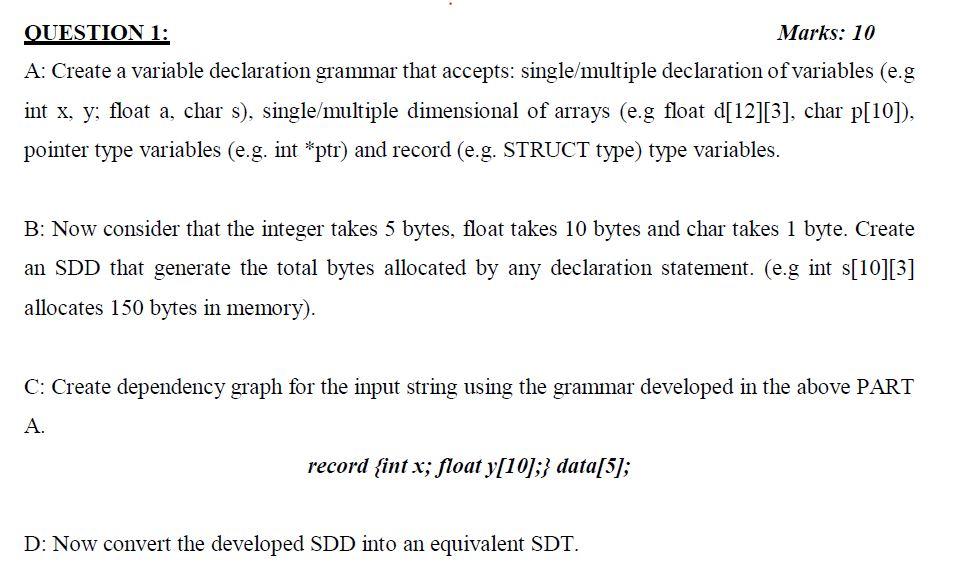
QUESTION 1: Marks: 10 A: Create a variable declaration grammar that accepts: single/multiple declaration of variables (e.g int x, y; float a, char s), single/multiple dimensional of arrays (e.g float d[12][3], char p[10]), pointer type variables (e.g. int *ptr) and record (e.g. STRUCT type) type variables. B: Now consider that the integer takes 5 bytes, float takes 10 bytes and char takes 1 byte. Create an SDD that generate the total bytes allocated by any declaration statement. (e.g int s[10][3] allocates 150 bytes in memory). C: Create dependency graph for the input string using the grammar developed in the above PART A. record {int x; float y[10];} data[5]; D: Now convert the developed SDD into an equivalent SDT
Step by Step Solution
There are 3 Steps involved in it

Get step-by-step solutions from verified subject matter experts
 Study Help