







Question: A D 1 Time Unit 2 18.30 3 17.50 5 4 12.80 8 5 11.30 12 6 10.00 17 7 8.50 21 8 18.90 24
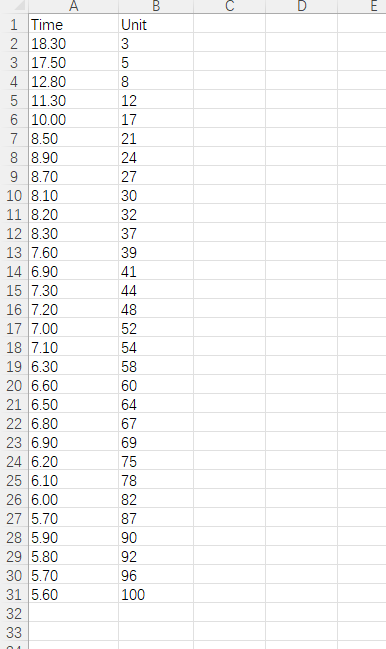
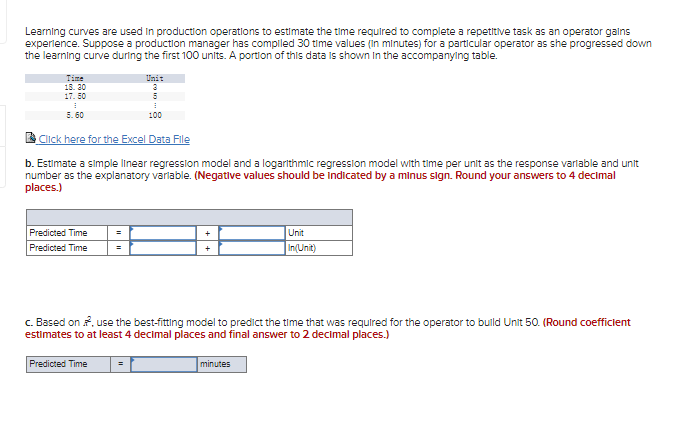
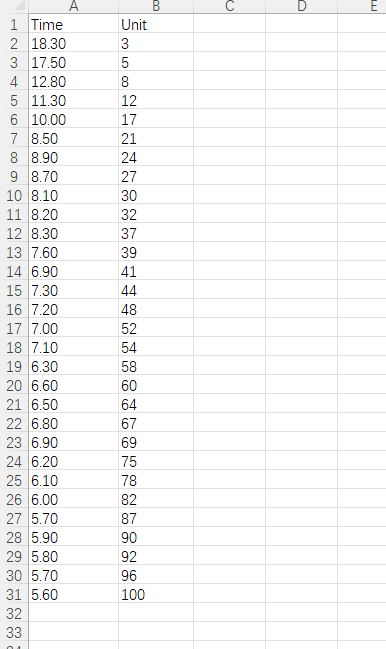
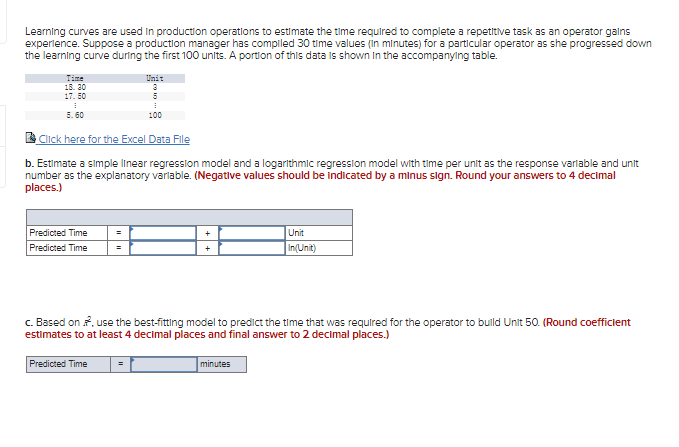
A D 1 Time Unit 2 18.30 3 17.50 5 4 12.80 8 5 11.30 12 6 10.00 17 7 8.50 21 8 18.90 24 9 18.70 27 10 8.10 30 11 8.20 32 12 8.30 37 13 7.60 39 14 6.90 41 15 7.30 44 16 7.20 48 17 7.00 52 18 7.10 54 19 6.30 58 20 6.60 60 21 6.50 64 22 6.80 67 23 6.90 69 24 6.20 75 25 6.10 78 26 6.00 82 27 5.70 87 28 5.90 90 29 5.80 92 30 5.70 96 31 5.60 100 32 33Learning curves are used In production operations to estimate the time required to complete a repetitive task as an operator gains experience. Suppose a production manager has compiled 30 time values (In minutes) for a particular operator as she progressed down the learning curve during the first 100 units. A portion of this data is shown In the accompanying table. Time Unit 15. 20 17. 50 5. 60 100 Click here for the Excel Data File b. Estimate a simple linear regression model and a logarithmic regression model with time per unit as the response variable and unit number as the explanatory variable. (Negative values should be indicated by a minus sign. Round your answers to 4 decimal places.) Predicted Time Unit Predicted Time In(Unit) c. Based on F, use the best-fitting model to predict the time that was required for the operator to build Unit 50. (Round coefficient estimates to at least 4 decimal places and final answer to 2 decimal places.) Predicted Time = minutes
Step by Step Solution
There are 3 Steps involved in it

Get step-by-step solutions from verified subject matter experts
 Study Help