







Question: A decision maker (receiver) must choose an action a. Her payoff depends on a and on an unknown state of the world . Suppose
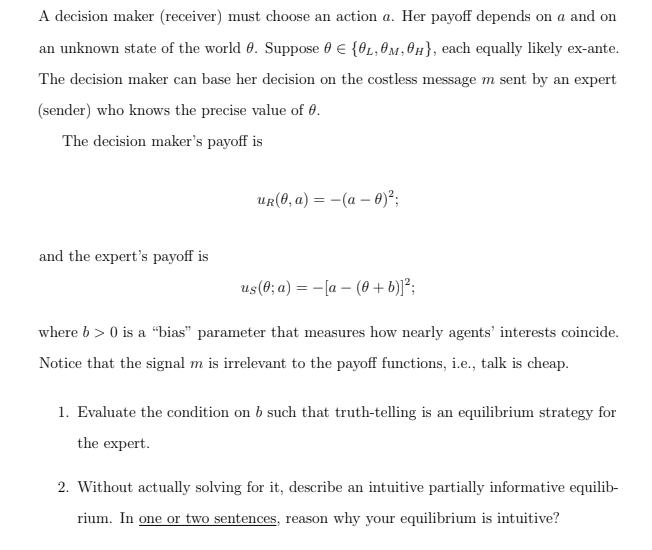
A decision maker (receiver) must choose an action a. Her payoff depends on a and on an unknown state of the world . Suppose 0 {OLOM, OH}, each equally likely ex-ante. The decision maker can base her decision on the costless message m sent by an expert (sender) who knows the precise value of 0. The decision maker's payoff is and the expert's payoff is UR(0, a)= (a -0); us (0; a) -[a- (0+ b)] ; where b> 0 is a "bias" parameter that measures how nearly agents' interests coincide. Notice that the signal m is irrelevant to the payoff functions, i.e., talk is cheap. 1. Evaluate the condition on b such that truth-telling is an equilibrium strategy for the expert. 2. Without actually solving for it, describe an intuitive partially informative equilib- rium. In one or two sentences, reason why your equilibrium is intuitive?
Step by Step Solution
There are 3 Steps involved in it
1 Condition for TruthTelling Equilibrium In a truthtelling equilibrium the expert finds it optimal t... View full answer

Get step-by-step solutions from verified subject matter experts
 Study Help