







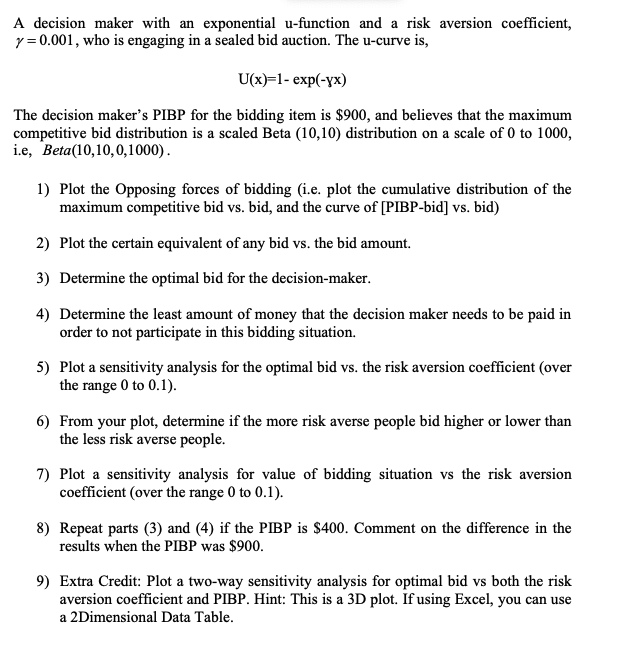
Question: A decision maker with an exponential u - function and a risk aversion coefficient, = 0 . 0 0 1 , who is engaging in
A decision maker with an exponential ufunction and a risk aversion coefficient,
who is engaging in a sealed bid auction. The ucurve is
exp
The decision maker's PIBP for the bidding item is $ and believes that the maximum
competitive bid distribution is a scaled Beta distribution on a scale of to
ie
Plot the Opposing forces of bidding ie plot the cumulative distribution of the
maximum competitive bid vs bid, and the curve of PIBPbid vs bid
Plot the certain equivalent of any bid vs the bid amount.
Determine the optimal bid for the decisionmaker.
Determine the least amount of money that the decision maker needs to be paid in
order to not participate in this bidding situation.
Plot a sensitivity analysis for the optimal bid vs the risk aversion coefficient over
the range to
From your plot, determine if the more risk averse people bid higher or lower than
the less risk averse people.
Plot a sensitivity analysis for value of bidding situation vs the risk aversion
coefficient over the range to
Repeat parts and if the PIBP is $ Comment on the difference in the
results when the PIBP was $
Extra Credit: Plot a twoway sensitivity analysis for optimal bid vs both the risk
aversion coefficient and PIBP. Hint: This is a D plot. If using Excel, you can use
a Dimensional Data Table.
Step by Step Solution
There are 3 Steps involved in it
1 Expert Approved Answer
Step: 1 Unlock

Question Has Been Solved by an Expert!
Get step-by-step solutions from verified subject matter experts
Step: 2 Unlock
Step: 3 Unlock
 Study Help