







Question: A DECISION PAYOFF MODEL Rexdale Retail is considering the quantity of smartwatches (150, 200, or 250 units) to order and, hopefully, sell during the next
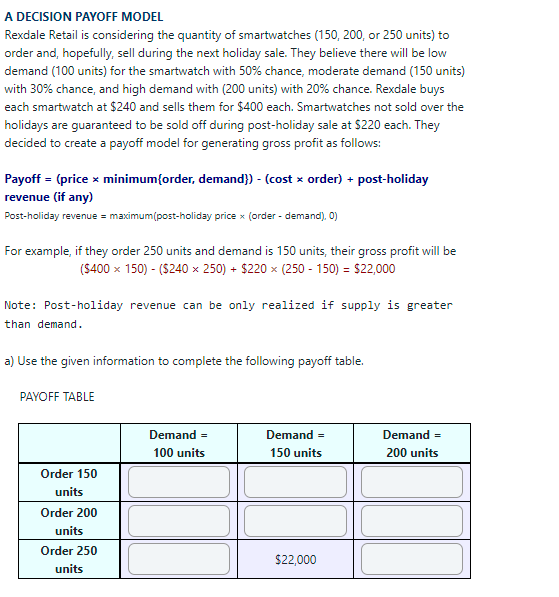
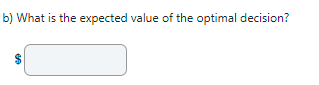
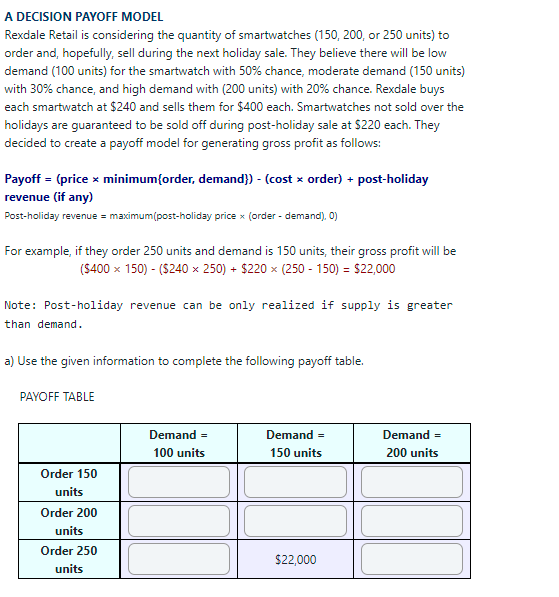
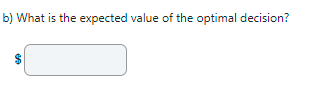
A DECISION PAYOFF MODEL Rexdale Retail is considering the quantity of smartwatches (150, 200, or 250 units) to order and, hopefully, sell during the next holiday sale. They believe there will be low demand (100 units) for the smartwatch with 50% chance, moderate demand (150 units) with 30% chance, and high demand with (200 units) with 20% chance. Rexdale buys each smartwatch at $240 and sells them for $400 each. Smartwatches not sold over the holidays are guaranteed to be sold off during post-holiday sale at $220 each. They decided to create a payoff model for generating gross profit as follows: Payoff = (price * minimum(order, demand]) - (cost * order) + post-holiday revenue (if any) Post-holiday revenue = maximum(post-holiday price x (order - demand), 0) For example, if they order 250 units and demand is 150 units, their gross profit will be ($400 x 150) - ($240 * 250) + $220 * (250 - 150) = $22,000 Note: Post-holiday revenue can be only realized if supply is greater than demand. a) Use the given information to complete the following payoff table. PAYOFF TABLE Demand = Demand = Demand = 100 units 150 units 200 units Order 150 units Order 200 units Order 250 $22,000 units
Step by Step Solution
There are 3 Steps involved in it

Get step-by-step solutions from verified subject matter experts
 Study Help