







Question: a) Design and code a C function named roots that calculates the roots of a quadratic equation. Your function receives three doubles that hold
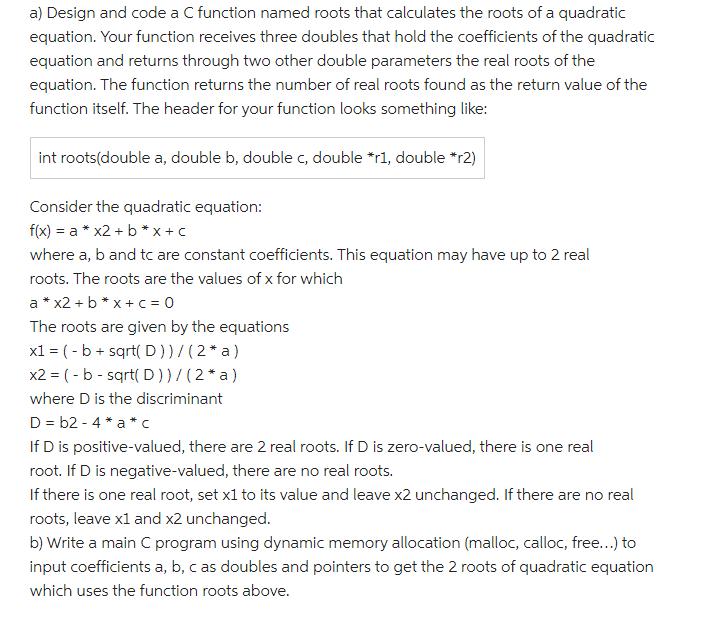
a) Design and code a C function named roots that calculates the roots of a quadratic equation. Your function receives three doubles that hold the coefficients of the quadratic equation and returns through two other double parameters the real roots of the equation. The function returns the number of real roots found as the return value of the function itself. The header for your function looks something like: int roots(double a, double b, double c, double *r1, double *r2) Consider the quadratic equation: f(x) = a* x2 + b*x+c where a, b and tc are constant coefficients. This equation may have up to 2 real roots. The roots are the values of x for which a * x2 + b * x + c = 0 The roots are given by the equations x1 = (-b+sqrt( D ))/(2* a) x2 = (- b - sqrt(D))/(2* a) where D is the discriminant D = b2 - 4*a* c If D is positive-valued, there are 2 real roots. If D is zero-valued, there is one real root. If D is negative-valued, there are no real roots. If there is one real root, set x1 to its value and leave x2 unchanged. If there are no real roots, leave x1 and x2 unchanged. b) Write a main C program using dynamic memory allocation (malloc, calloc, free...) to input coefficients a, b, c as doubles and pointers to get the 2 roots of quadratic equation which uses the function roots above.
Step by Step Solution
3.45 Rating (142 Votes )
There are 3 Steps involved in it
The detailed ... View full answer

Get step-by-step solutions from verified subject matter experts
 Study Help