







Question: (a) Determine an un-simplified logic R function for the output of the logic network shown here. Then, simplify the logic function as much as possible
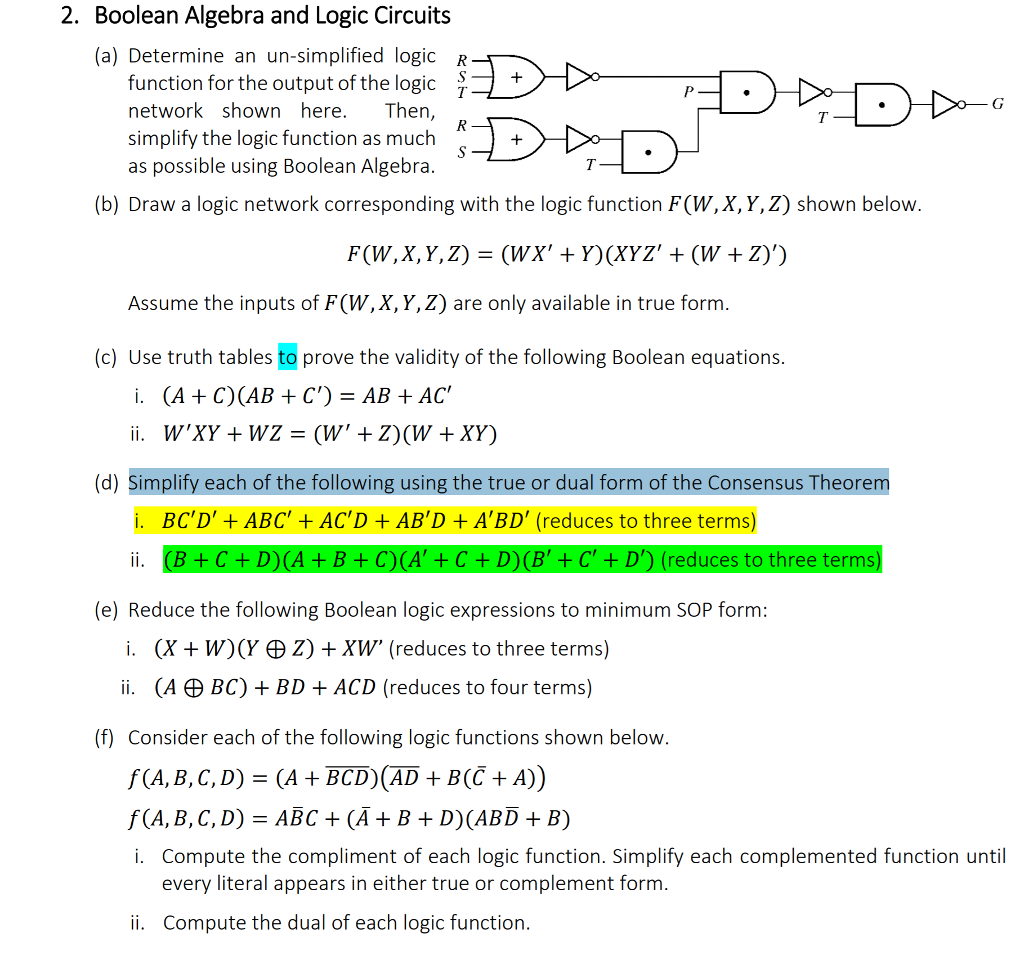
(a) Determine an un-simplified logic R function for the output of the logic network shown here. Then, simplify the logic function as much as possible using Boolean Algebra. (b) Draw a logic network corresponding with the logic function F(W, X, Y, Z) shown below. F(W, X, Y, Z) = (WX' + Y)(XYZ' + (W + Z)) Assume the inputs of F(W, X, Y, Z) are only available in true form. (c) Use truth tables to prove the validity of the following Boolean equations. i. (A + C)(AB + C') = AB + AC', ii. W'XY + WZ = (W' + Z)(W + XY) (d) Simplify each of the following using the true or dual form of the Consensus Theorem i. BC'D' + ABC' + AC'D + AB'D + A'BD' (reduces to three terms) ii. (B + C + D)(A + B + C)(A' + C + D)(B' + C + D') (reduces to three terms) (e) Reduce the following Boolean logic expressions to minimum SOP form: i. (X + W)(Y Z) + XW' (reduces to three terms) ii. (A BC) + BD + ACD (reduces to four terms) (f) Consider each of the following logic functions shown below. f(A, B, C, D) = (A + BC)(AD + B(C + A)) f(A, B, C, D) = ABC + (A + B + D)(ABD + B) i. Compute the compliment of each logic function. Simplify each complemented function until every literal appears in either true or complement form. ii. Compute the dual of each logic function
Step by Step Solution
There are 3 Steps involved in it

Get step-by-step solutions from verified subject matter experts
 Study Help