



Question: a) Determine the 1st player and 2nd player (5pts) b) Draw the following game in extensive form (20pts). c) Apply the backward induction and
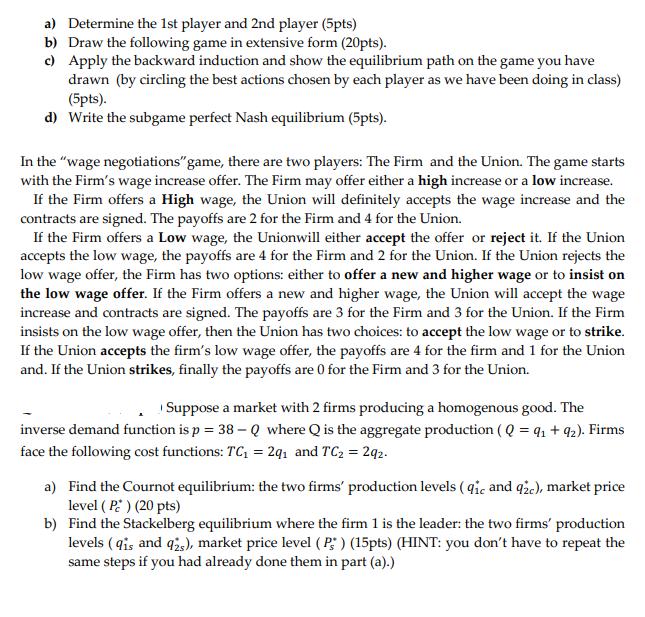
a) Determine the 1st player and 2nd player (5pts) b) Draw the following game in extensive form (20pts). c) Apply the backward induction and show the equilibrium path on the game you have drawn (by circling the best actions chosen by each player as we have been doing in class) (5pts). d) Write the subgame perfect Nash equilibrium (5pts). In the "wage negotiations" game, there are two players: The Firm and the Union. The game starts with the Firm's wage increase offer. The Firm may offer either a high increase or a low increase. If the Firm offers a High wage, the Union will definitely accepts the wage increase and the contracts are signed. The payoffs are 2 for the Firm and 4 for the Union. If the Firm offers a Low wage, the Unionwill either accept the offer or reject it. If the Union accepts the low wage, the payoffs are 4 for the Firm and 2 for the Union. If the Union rejects the low wage offer, the Firm has two options: either to offer a new and higher wage or to insist on the low wage offer. If the Firm offers a new and higher wage, the Union will accept the wage increase and contracts are signed. The payoffs are 3 for the Firm and 3 for the Union. If the Firm insists on the low wage offer, then the Union has two choices: to accept the low wage or to strike. If the Union accepts the firm's low wage offer, the payoffs are 4 for the firm and 1 for the Union and. If the Union strikes, finally the payoffs are 0 for the Firm and 3 for the Union. Suppose a market with 2 firms producing a homogenous good. The inverse demand function is p = 38 - Q where Q is the aggregate production (Q = 9 +9). Firms face the following cost functions: TC = 29 and TC = 292. a) Find the Cournot equilibrium: the two firms' production levels (qic and 92c), market price level (P) (20 pts) b) Find the Stackelberg equilibrium where the firm 1 is the leader: the two firms' production levels (qis and q25), market price level (P) (15pts) (HINT: you don't have to repeat the same steps if you had already done them in part (a).)
Step by Step Solution
3.45 Rating (148 Votes )
There are 3 Steps involved in it

Get step-by-step solutions from verified subject matter experts