







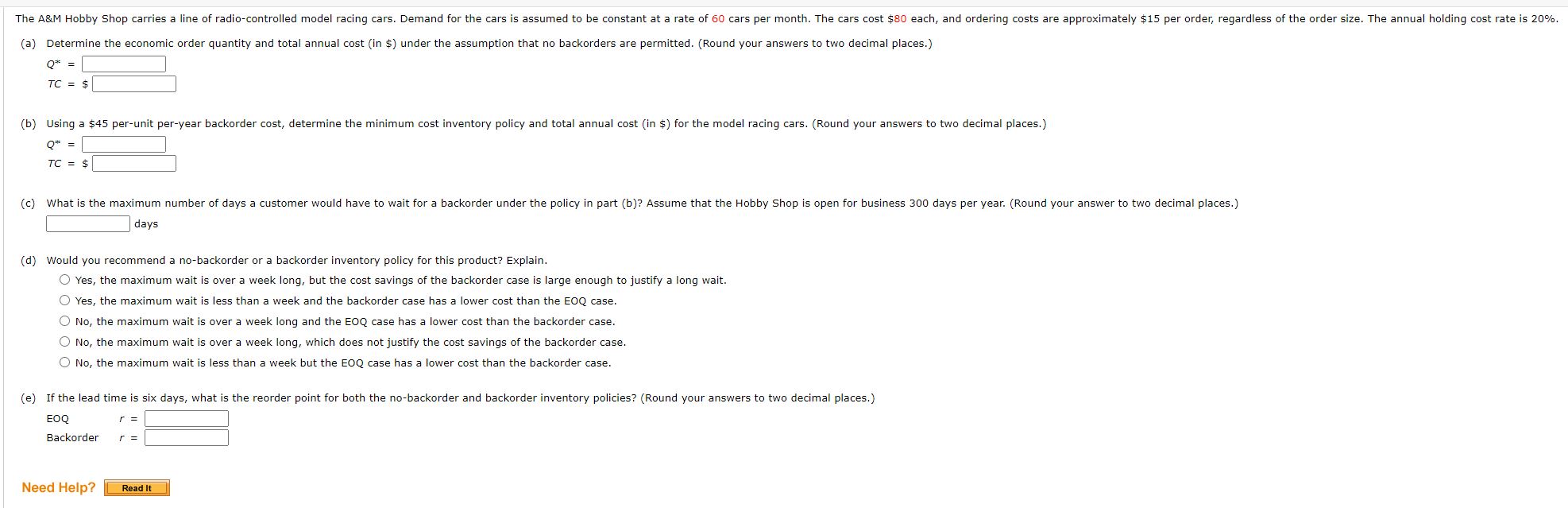
Question: ( a ) Determine the economic order quantity and total annual cost ( in $ ) under the assumption that no backorders are permitted. (
a Determine the economic order quantity and total annual cost in $ under the assumption that no backorders are permitted. Round your answers to two decimal places.
$
b Using a $ perunit peryear backorder cost, determine the minimum cost inventory policy and total annual cost in $ for the model racing cars. Round your answers to two decimal places.
$
days
d Would you recommend a nobackorder or a backorder inventory policy for this product? Explain.
Yes, the maximum wait is over a week long, but the cost savings of the backorder case is large enough to justify a long wait.
Yes, the maximum wait is less than a week and the backorder case has a lower cost than the EOQ case.
No the maximum wait is over a week long and the EOQ case has a lower cost than the backorder case.
No the maximum wait is over a week long, which does not justify the cost savings of the backorder case.
No the maximum wait is less than a week but the EOQ case has a lower cost than the backorder case.
e If the lead time is six days, what is the reorder point for both the nobackorder and backorder inventory policies? Round your answers to two decimal places.
EOQ
Backorder
Need Help?
Step by Step Solution
There are 3 Steps involved in it
1 Expert Approved Answer
Step: 1 Unlock

Question Has Been Solved by an Expert!
Get step-by-step solutions from verified subject matter experts
Step: 2 Unlock
Step: 3 Unlock
 Study Help