







Question: (a) Develop a pairwise comparison matrix (b) Determine the priorities relative to the performance criterion (c) compute the consistency ratio. I apologize for the inconvenience,
(a) Develop a pairwise comparison matrix
(b) Determine the priorities relative to the performance criterion
(c) compute the consistency ratio.
I apologize for the inconvenience, I was lost too. Please assist me as this is my assignment due on the 07th of October 2020
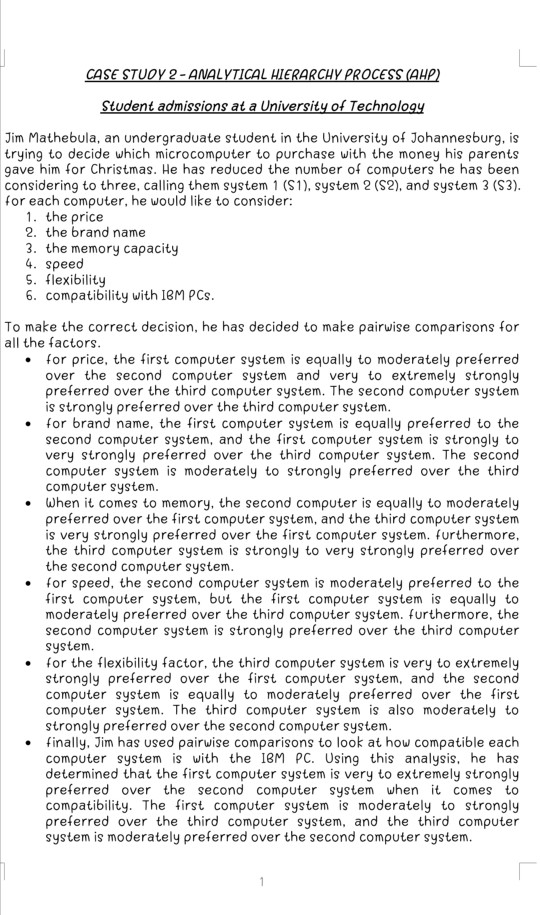
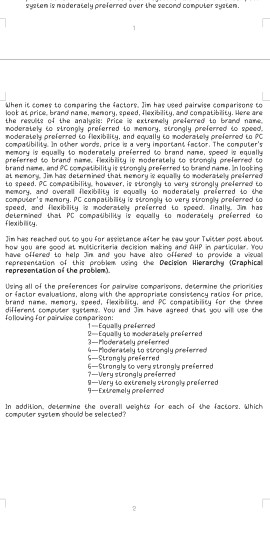
CASE STUOY 2 - ANALYTICAL HIERARCHY PROCESS (AHP) Student admissions at a University of Technology Jim Mathebula, an undergraduate student in the University of Johannesburg, is trying to decide which microcomputer to purchase with the money his parents gave him for Christmas. He has reduced the number of computers he has been considering to three, calling them system 1 (S1), system 2 (S2), and system 3 (53). for each computer, he would like to consider: 1. the price 2. the brand name 3. the memory capacity 4. speed 5. flexibility 6. compatibility with IBM PCs. To make the correct decision, he has decided to make pairwise comparisons for all the factors. for price, the first computer system is equally to moderately preferred over the second computer system and very to extremely strongly preferred over the third computer system. The second computer system is strongly preferred over the third computer system. for brand name, the first computer system is equally preferred to the second computer system, and the first computer system is strongly to very strongly preferred over the third computer system. The second computer system is moderately to strongly preferred over the third computer system. When it comes to memory, the second computer is equally to moderately preferred over the first computer system, and the third computer system is very strongly preferred over the first computer system. furthermore, the third computer system is strongly to very strongly preferred over the second computer system. for speed, the second computer system is moderately preferred to the first computer system, but the first computer system is equally to moderately preferred over the third computer system. furthermore, the second computer system is strongly preferred over the third computer system. for the flexibility factor, the third computer system is very to extremely strongly preferred over the first computer system, and the second computer system is equally to moderately preferred over the first computer system. The third computer system is also moderately to strongly preferred over the second computer system. finally, Jim has used pairwise comparisons to look at how compatible each computer system is with the IBM PC. Using this analysis, he has determined that the first computer system is very to extremely strongly preferred over the second computer system when it comes to compatibility. The first computer system is moderately to strongly preferred over the third computer system, and the third computer system is moderately preferred over the second computer system. brand Moderately to strongly preferred sya ten is noderately preferred over the second computer syaten. When it comes to conparing the factors. Jin has used pairwise conparisone to look at price, brand nane, menory, speed, Hexibility, and conpatibility. Here are moderately to strongly preferred to menory, strongly preferred to speed moderately prelerred to Flexibility, and equally to moderately preferred to PC compatibility. In other words. price is a very important factor. The con memory's equally to moderately preferred to brand nane, speed equally preferred to brand name flexibility is noderately to strongly preferred to and PC compatibility is strongly preferred to brand rane. In locking at nenoryJin has determined that nenor e equally to moderately preferred to speed. PC compatibility, however, is strongly to very strongly preferred to memory, and overall flexibility is equally to noderately preferred to the computer's menory. PC compatibility is strongly to very strongly preferred to speed, and flexibility is moderately preferred to speed linally, Jn has delerined that PC compatibility is equally to moderately preferred to flexible Jin has reached out to you for assistance after he saw your Tuitter post about how you are good at multicriteris decision making and AHP in particular. You have offered to help yn and you have also offered to provide a visual representation of this problem using the Decision Hierarchy (Graphical representation of the problem). Using all of the preferences for paruise comparisons, determine the priorities or factor evaluations, along with the appropriate consistency ratlos for price brand name memory, speed, flexibility, and PC conpatibility for the three different computer systems. You and Jin have agreed that you will use the following for paruise comparison 1 - Equally preferred 3-Equally to moderately preferred 3- Moderately preferred preferred 6-Strongly to very strongly prelerred 7- very strongly preferred 9- Very to extrenely strongly preferred 9-Extremely prelerred In addition determine the overall weights for each of the factors, which computer syylon should be selectedStep by Step Solution
There are 3 Steps involved in it
1 Expert Approved Answer
Step: 1 Unlock

Question Has Been Solved by an Expert!
Get step-by-step solutions from verified subject matter experts
Step: 2 Unlock
Step: 3 Unlock
 Study Help