







Question: A diagnostic test for a certain disease is applied to n individuals known to not have the disease. Let X = the number among the
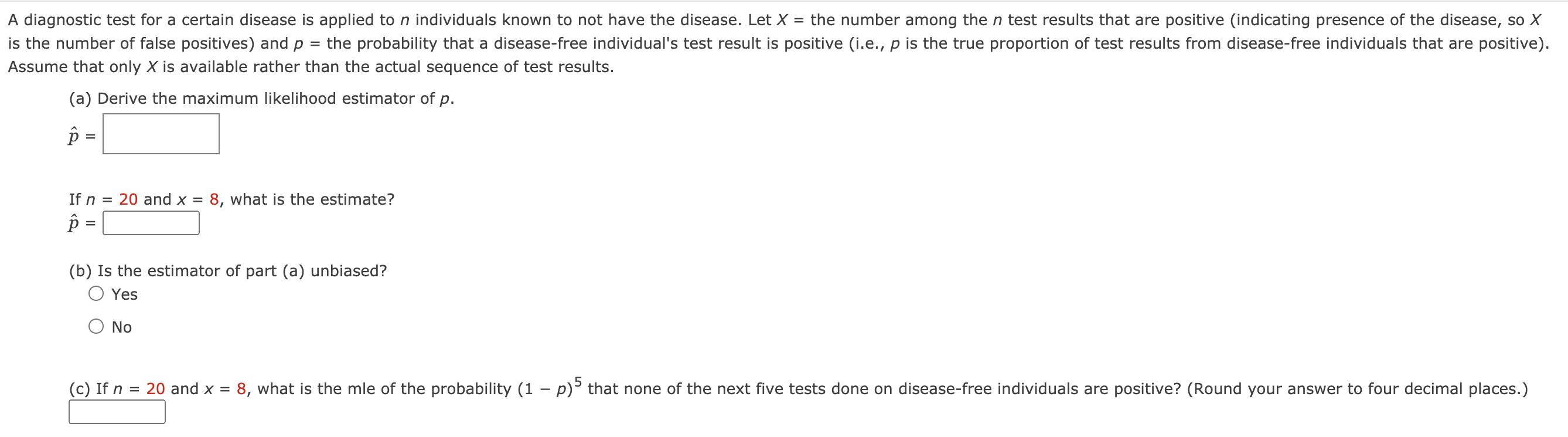
A diagnostic test for a certain disease is applied to n individuals known to not have the disease. Let X = the number among the 1': test results that are positive (indicating presence of the disease, so X is the number of false positives) and p = the probability that a disease-free individual's test result is positive (i.e., p is the true proportion of test results from disease-free individuals that are positive). Assume that only X is available rather than the actual sequence of test results. (a) Derive the maximum likelihood estimator of p. i2 If 13 2 = 20 and x = 8, what is the estimate? (b) Is the estimator of part (a) unbiased? 0 Yes 0 No (c) If n = 20 and x = 8, what is the mle of the probability (1 p)5 that none of the next ve tests done on disease-free individuals are positive? (Round your answer to four decimal places.)
Step by Step Solution
There are 3 Steps involved in it

Get step-by-step solutions from verified subject matter experts
 Study Help