







Question: A discharge of ( 1 . 2 mathrm { ~m } ^ { 3 } / mathrm { s } )
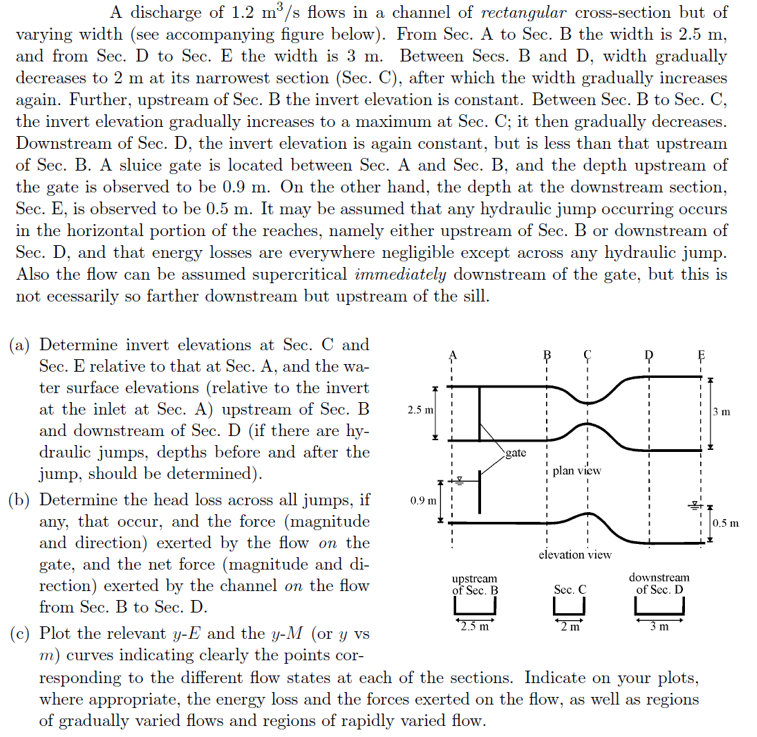
A discharge of mathrm~mmathrms flows in a channel of rectangular crosssection but of varying width see accompanying figure below From Sec. A to Sec. B the width is m and from Sec. D to Sec. E the width is m Between Secs. B and D width gradually decreases to m at its narrowest section Sec C after which the width gradually increases again. Further, upstream of Sec. B the invert elevation is constant. Between Sec. B to Sec. C the invert elevation gradually increases to a maximum at mathrmSecmathrmC; it then gradually decreases. Downstream of Sec. D the invert elevation is again constant, but is less than that upstream of Sec. B A sluice gate is located between Sec. A and Sec. B and the depth upstream of the gate is observed to be m On the other hand, the depth at the downstream section, Sec. E is observed to be m It may be assumed that any hydraulic jump occurring occurs in the horizontal portion of the reaches, namely either upstream of Sec. B or downstream of Sec. D and that energy losses are everywhere negligible except across any hydraulic jump. Also the flow can be assumed supercritical immediately downstream of the gate, but this is not ecessarily so farther downstream but upstream of the sill.
a Determine invert elevations at Sec. C and Sec. E relative to that at Sec. A and the water surface elevations relative to the invert at the inlet at Sec. A upstream of Sec. B and downstream of Sec. D if there are hydraulic jumps, depths before and after the jump, should be determined
b Determine the head loss across all jumps, if any, that occur, and the force magnitude and direction exerted by the flow on the gate, and the net force magnitude and direction exerted by the channel on the flow from Sec. B to Sec. D
c Plot the relevant y E and the y M or y vs
stackrelrightharpoonup mathrm~mrightleftarrows mathrm~mquad stackrelmathrm~mrightleftarrows
m curves indicating clearly the points corresponding to the different flow states at each of the sections. Indicate on your plots, where appropriate, the energy loss and the forces exerted on the flow, as well as regions of gradually varied flows and regions of rapidly varied flow.
Step by Step Solution
There are 3 Steps involved in it
1 Expert Approved Answer
Step: 1 Unlock

Question Has Been Solved by an Expert!
Get step-by-step solutions from verified subject matter experts
Step: 2 Unlock
Step: 3 Unlock
 Study Help