







Question: A. D(q.) B. S(a. (@) 1. total surplus C. gc - S(ge) o . ge 2. equilibrium price D. L S(g)dg 3. value to suppliers
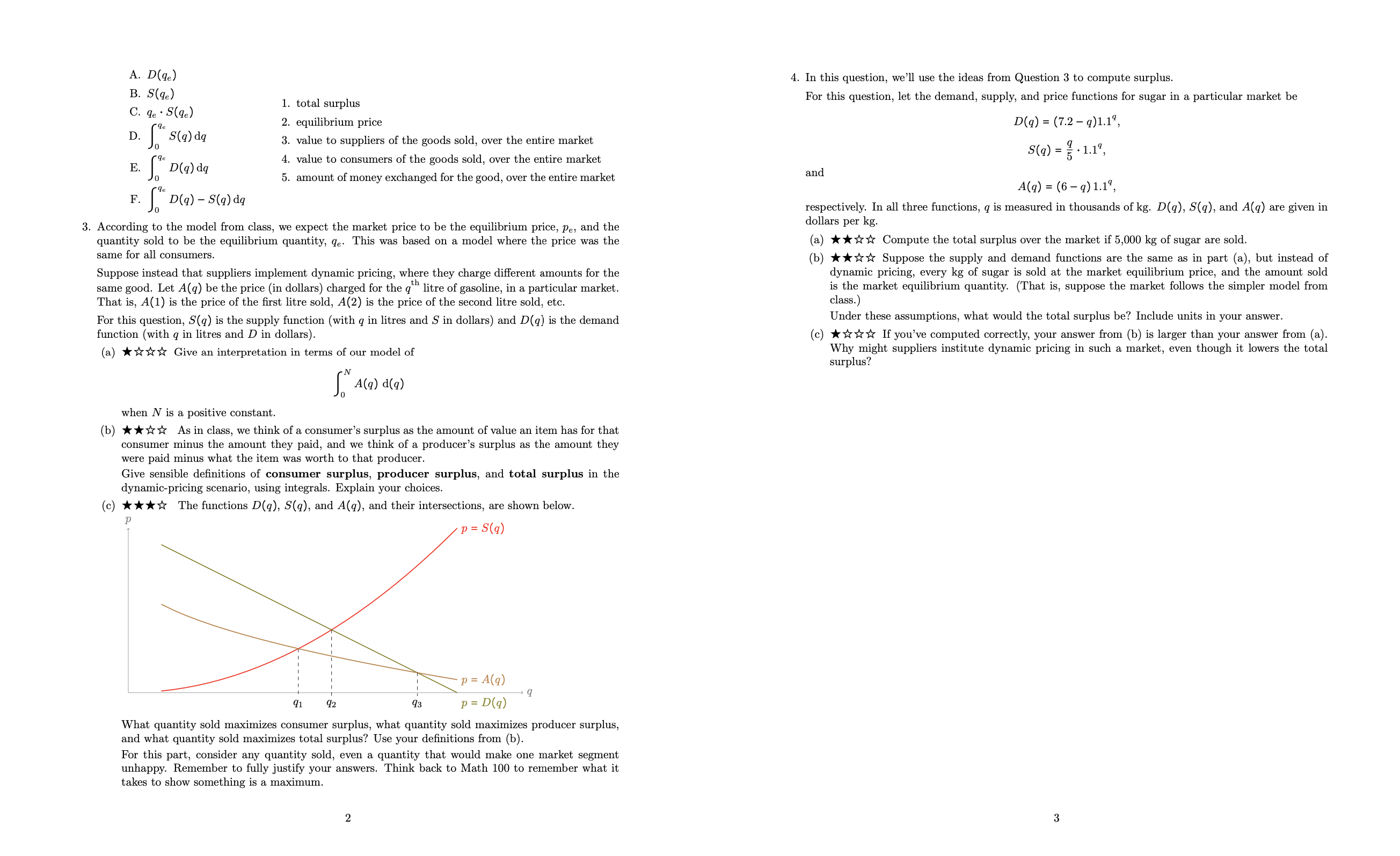
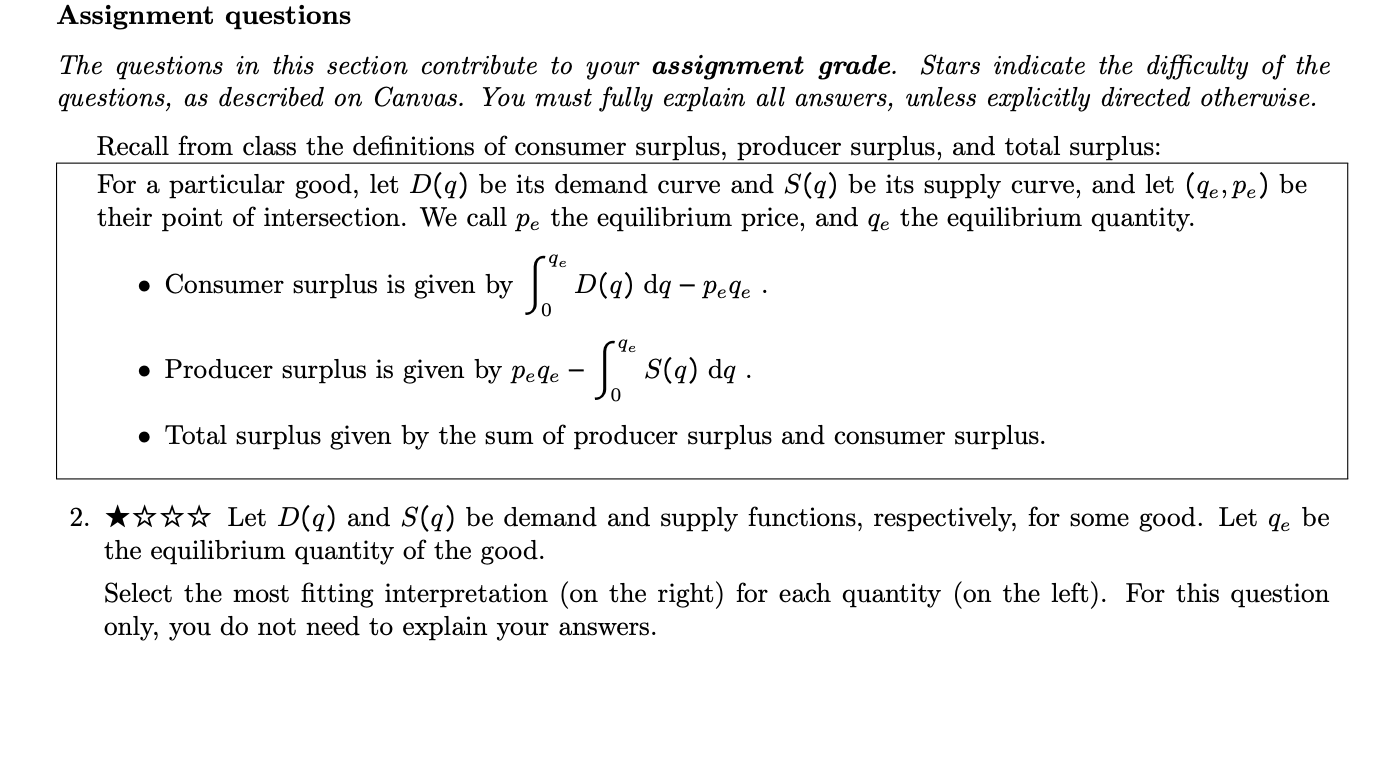
A. D(q.) B. S(a. (@) 1. total surplus C. gc - S(ge) o . ge 2. equilibrium price D. L S(g)dg 3. value to suppliers of the goods sold, over the entire market % J'm Blald 4. value to consumers of the goods sold, over the entire market \" )y O 5. amount of money exchanged for the good, over the entire market a F. [ D) - st g 3. According to the model from class, we expect the market price to be the equilibrium price, p,, and the quantity sold to be the equilibrium quantity, g.. This was based on a model where the price was the same for all consumers. Suppose instead that suppliers implement dynamic pricing, where they charge different amounts for the same good. Let A(g) be the price (in dollars) charged for the '* litre of gasoline, in a particular market. That is, A(1) is the price of the first litre sold, A(2) is the price of the second litre sold, etc. For this question, S(g) is the supply function (with in litres and in dollars) and D(g) is the demand function (with in litres and D in dollars). (a) %Y Give an interpretation in terms of our model of N J, 4t ata) when N is a positive constant. (b, * kt As in class, we think of a consumer's surplus as the amount of value an item has for that consumer minus the amount they paid, and we think of a producer's surplus as the amount they were paid minus what the item was worth to that producer. Give sensible definitions of consumer surplus, producer surplus, and total surplus in the dynamic-pricing scenario, using integrals. Explain your choices. (c) %% % The functions D(g), S(q), and A(g), and their intersections, are shown below. 2 p=5(q) p=D(q) What quantity sold maximizes consumer surplus, what quantity sold maximizes producer surplus, and what quantity sold maximizes total surplus? Use your definitions from (b). For this part, consider any quantity sold, even a quantity that would make one market segment unhappy. Remember to fully justify your answers. Think back to Math 100 to remember what it takes to show something is a maximum. 4. Tn this question, we'll use the ideas from Question 3 to compute surplus. For this question, let the demand, supply, and price functions for sugar in a particular market be D(q) = (72~ q)L.1%, S(g) = 5117, and Alg) = (6-q) 117, respectively. In all three functions, g is measured in thousands of kg. D(g), S(g), and A(q) are given in dollars per kg. (a) %K%+ Compute the total surplus over the market if 5,000 kg of sugar are sold. (b) %%+ Suppose the supply and demand functions are the same as in part (a), but instead of dynamic pricing, every kg of sugar is sold at the market equilibrium price, and the amount sold is the market equilibrium quantity. (That is, suppose the market follows the simpler model from class.) Under these assumptions, what would the total surplus be? Include units in your answer. (c) % If you've computed correctly, your answer from (b) is larger than your answer from (a). Why might suppliers institute dynamic pricing in such a market, even though it lowers the total surplus? Assignment questions The questions in this seclion contribute to your assignment grade. Stars indicate the difficulty of the questions, as described on Canvas. You must fully explain all answers, unless explicitly directed otherwise. Recall from class the definitions of consumer surplus, producer surplus, and total surplus: For a particular good, let D(q) be its demand curve and S(q) be its supply curve, and let (q.,p.) be their point of intersection. We call p. the equilibrium price, and g, the equilibrium quantity. QE e Consumer surplus is given by J D(q) dg p.qe . 0 qE e Producer surplus is given by p.q. j S(q) dq . 0 e Total surplus given by the sum of producer surplus and consumer surplus. 2. wYrr Let D(q) and S(g) be demand and supply functions, respectively, for some good. Let g, be the equilibrium quantity of the good. Select the most fitting interpretation (on the right) for each quantity (on the left). For this question only, you do not need to explain your answers
Step by Step Solution
There are 3 Steps involved in it

Get step-by-step solutions from verified subject matter experts
 Study Help