







Question: a. Every function which can be expressed in closed form has a closed formderivative TRUE or FALSE??? b. Every function which can be expressed in
a. Every function which can be expressed in closed form has a closed formderivative TRUE or FALSE???
b. Every function which can be expressed in closed form has a closed formantiderivative. TRUE or FALSE??
c.
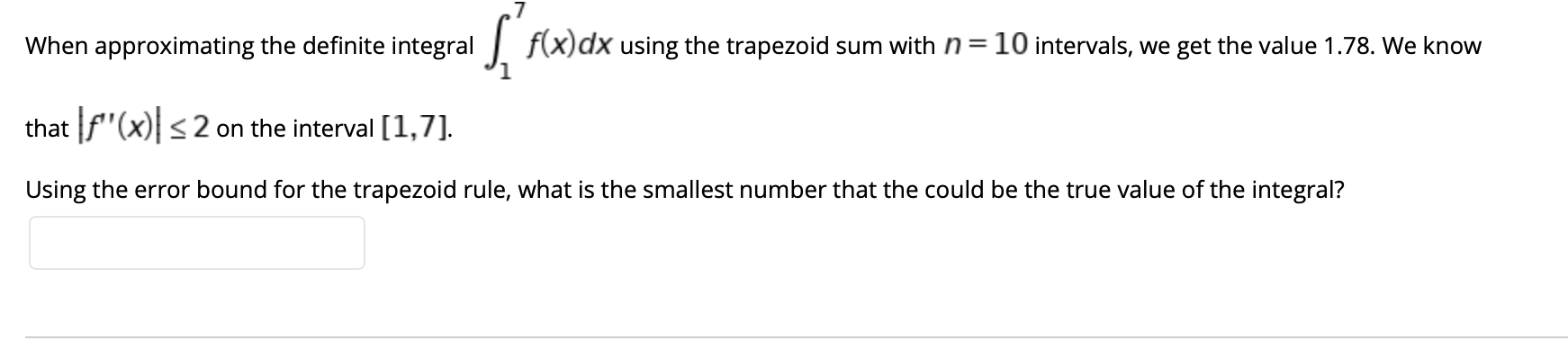
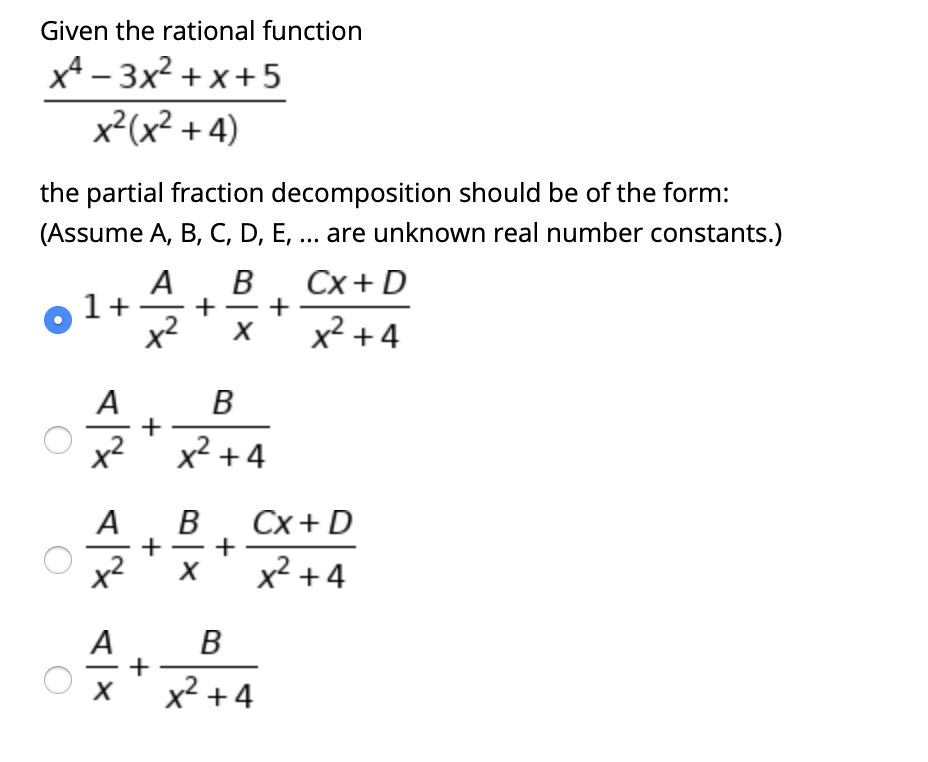
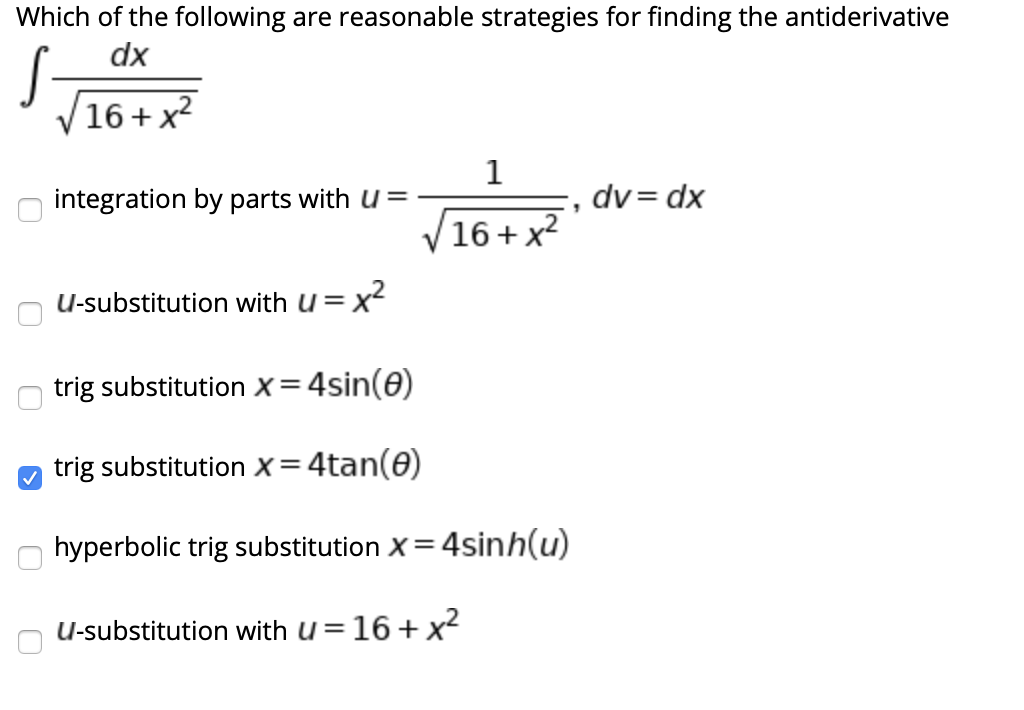
When approximationg the definite integral f(x)dx using the trapezoid sum with / = 10 intervals, we get the value 1.78. We know that f" (x)| $ 2 on the interval [1, 7]. Using the error bound for the trapezoid rule, what is the smallest number that the could be the true value of the integral?Given the rational function x4-3x2+x+5 x2(x2+4) the partial fraction decomposition should be of the form: (Assume A, B, C D E are unknown real number constants.) A B CX+D 017*?* x2\" (\"+1 B \"ff-Ix: A w 6x2 x2+4 A: B X x2+4 Which of the following are reasonable strategies for finding the antiderivative dx 16+ x2 integration by parts with U = dv = dx 16 + x2 U-substitution with u = x2 trig substitution X = 4sin(0) trig substitution X = 4tan(0) hyperbolic trig substitution x = 4sinh(u) U-substitution with u = 16 + x2
Step by Step Solution
There are 3 Steps involved in it

Get step-by-step solutions from verified subject matter experts
 Study Help