







Question: A experiment using a single replicate of a 2 4 factorial design. After analyzing the data, the following results are available: Model Term Effect Estimate
- A experiment using a single replicate of a 24 factorial design. After analyzing the data, the following results are available:
Model Term | Effect Estimate | Sum of Squares | % Contribution |
Intercept | X | X | X |
A-A | -9.75 | 380.25 | 40.4952 |
B-B | -0.25 | 0.0266241 | |
C-C | -0.25 | 0.25 | 0.0266241 |
D-D | 90.25 | 9.61129 | |
AB | 4.5 | 81 | |
AC | 0.5 | 1 | 0.106496 |
AD | -3.5 | 49 | 5.21832 |
BC | -1 | 4 | 0.425985 |
BD | -2 | 16 | 1.70394 |
CD | 1 | 4 | 0.425985 |
ABC | -6.25 | 156.25 | 16.64 |
ABD | 4.75 | 90.25 | 9.61129 |
ACD | -0.25 | 0.25 | 0.0266241 |
BCD | -2.75 | 30.25 | 3.22151 |
ABCD | 3 | 3.83387 |
The grand average of all 16 observations is 83.75 and the total sum of squares is 939.00.
Answer the following questions.
- Fill in the 4 blanks in the table above,
- Is this an I-optimal design (circle the correct answer)? Yes
- A experimenter also ran 4 center points (the response data is not included in the calculations above) and observed the following results: 88 89, 92, and 87. The mean square for pure error is
- 2.00
- 3.85
- 4.67
- 5.25
- None of the above
- The value of the F-statistic for pure quadratic curvature is
- 10.51
- 9.98
- 8.75
- 9.50
- None of the above
- The table below shows the coded and natural (engineering) units for the factors. Find the regression model(s) for predicting the response in terms of the natural units assuming that the model contains only the main effects of A and D and the AD interaction.
Factor | Natural levels | Coded levels (x’s) |
A – time | 80, 120 (minutes) | -1, 1 |
B - temperature | 150, 200 (deg C) | -1, 1 |
C - pressure | (100, 150) psi | -1, 1 |
D - catalyst type | Organic, inorganic | -1, 1 |
- Consider the 22 factorial design shown
- Write the design matrix in coded units and the appropriate response totals in the table below.
Run | Response | ||
1 | |||
2 | |||
3 | |||
4 |
- What is the estimate of the AB interaction effect?
- What is the model regression coefficient for the AB interaction effect? __________________
- In the full model ANOVA how many degrees of freedom are available for pure error?
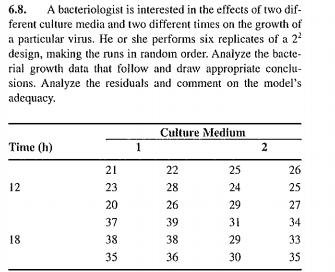
6.8. A bacteriologist is interested in the effects of two dif- ferent culture media and two different times on the growth of a particular virus. He or she performs six replicates of a 2 design, making the runs in random order. Analyze the bacte- rial growth data that follow and draw appropriate conclu- sions. Analyze the residuals and comment on the model's adequacy. Time (h) 12 18 21 23 20 37 38 35 1 Culture Medium 22 28 26 39 38 36 25 24 29 31 29 30 2 26 25 27 34 33 35
Step by Step Solution
3.39 Rating (168 Votes )
There are 3 Steps involved in it
The image you sent shows a question about the output voltage of a linear voltage re... View full answer

Get step-by-step solutions from verified subject matter experts
 Study Help