







Question: A family farm. What are the decision variables, objective function, and constraints? A farm family owns 100 acres of land and has $25,000 in funds
A family farm.
What are the decision variables, objective function, and constraints? 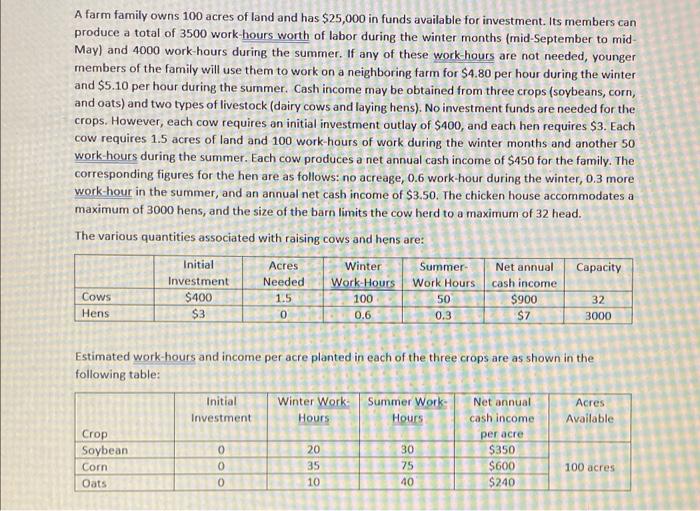
A farm family owns 100 acres of land and has $25,000 in funds available for investment. Its members can produce a total of 3500 work hours worth of labor during the winter months (mid-September to mid- May) and 4000 work hours during the summer. If any of these work hours are not needed, younger members of the family will use them to work on a neighboring farm for $4.80 per hour during the winter and $5.10 per hour during the summer. Cash income may be obtained from three crops (soybeans, corn, and oats) and two types of livestock (dairy cows and laying hens). No investment funds are needed for the crops. However, each cow requires an initial investment outlay of $400, and each hen requires $3. Each cow requires 1.5 acres of land and 100 work hours of work during the winter months and another 50 work hours during the summer. Each cow produces a net annual cash income of $450 for the family. The corresponding figures for the hen are as follows: no acreage, 0.6 work-hour during the winter, 0.3 more work hour in the summer, and an annual net cash income of $3.50. The chicken house accommodates a maximum of 3000 hens, and the size of the barn limits the cow herd to a maximum of 32 head. The various quantities associated with raising cows and hens are: Initial Acres Winter Summer Net annual Capacity Investment Needed Work-Hours Work Hours cash income Cows $400 1.5 100 $900 32 Hens $3 0.3 $7 3000 50 0 0.6 Estimated work hours and income per acre planted in each of the three crops are as shown in the following table: Initial Winter Work: Summer Work- Net annual Acres Investment Hours Hours cash income Available Crop per acre Soybean 20 30 $350 Corn 0 35 75 $600 100 acres Oats 0 10 40 $240 0 A farm family owns 100 acres of land and has $25,000 in funds available for investment. Its members can produce a total of 3500 work hours worth of labor during the winter months (mid-September to mid- May) and 4000 work hours during the summer. If any of these work hours are not needed, younger members of the family will use them to work on a neighboring farm for $4.80 per hour during the winter and $5.10 per hour during the summer. Cash income may be obtained from three crops (soybeans, corn, and oats) and two types of livestock (dairy cows and laying hens). No investment funds are needed for the crops. However, each cow requires an initial investment outlay of $400, and each hen requires $3. Each cow requires 1.5 acres of land and 100 work hours of work during the winter months and another 50 work hours during the summer. Each cow produces a net annual cash income of $450 for the family. The corresponding figures for the hen are as follows: no acreage, 0.6 work-hour during the winter, 0.3 more work hour in the summer, and an annual net cash income of $3.50. The chicken house accommodates a maximum of 3000 hens, and the size of the barn limits the cow herd to a maximum of 32 head. The various quantities associated with raising cows and hens are: Initial Acres Winter Summer Net annual Capacity Investment Needed Work-Hours Work Hours cash income Cows $400 1.5 100 $900 32 Hens $3 0.3 $7 3000 50 0 0.6 Estimated work hours and income per acre planted in each of the three crops are as shown in the following table: Initial Winter Work: Summer Work- Net annual Acres Investment Hours Hours cash income Available Crop per acre Soybean 20 30 $350 Corn 0 35 75 $600 100 acres Oats 0 10 40 $240 0
Step by Step Solution
There are 3 Steps involved in it
1 Expert Approved Answer
Step: 1 Unlock

Question Has Been Solved by an Expert!
Get step-by-step solutions from verified subject matter experts
Step: 2 Unlock
Step: 3 Unlock
 Study Help