







Question: A farmer has a small greenhouse made from thin sheets of mylar. On clear nights, due to the presence of moisture, ice forms on the
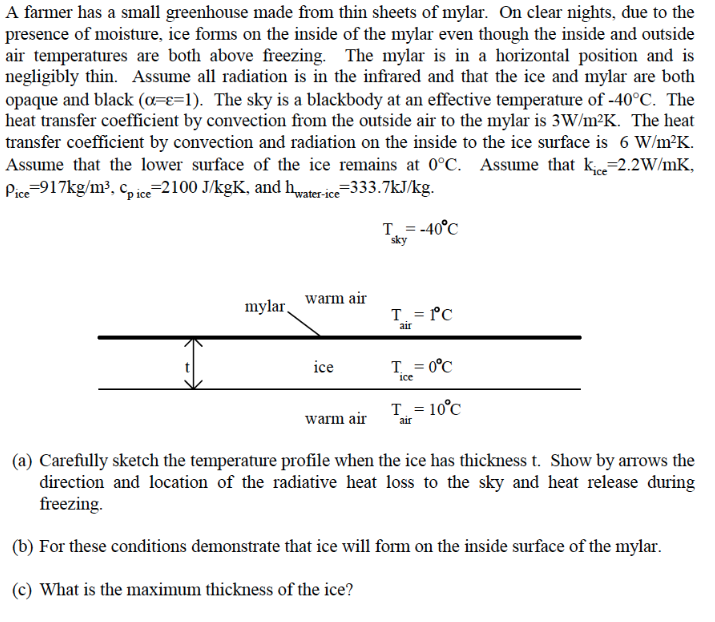
A farmer has a small greenhouse made from thin sheets of mylar. On clear nights, due to the presence of moisture, ice forms on the inside of the mylar even though the inside and outside air temperatures are both above freezing. The mylar is in a horizontal position and is negligibly thin. Assume all radiation is in the infrared and that the ice and mylar are both opaque and black (==1). The sky is a blackbody at an effective temperature of 40C. The heat transfer coefficient by convection from the outside air to the mylar is 3W/m2K. The heat transfer coefficient by convection and radiation on the inside to the ice surface is 6W/m2K. Assume that the lower surface of the ice remains at 0C. Assume that kice=2.2W/mK, ice=917kg/m3,cpice=2100J/kgK, and hwater-ice=333.7kJ/kg. Tsky=40C (a) Carefully sketch the temperature profile when the ice has thickness t. Show by arrows the direction and location of the radiative heat loss to the sky and heat release during freezing. (b) For these conditions demonstrate that ice will form on the inside surface of the mylar. (c) What is the maximum thickness of the ice
Step by Step Solution
There are 3 Steps involved in it

Get step-by-step solutions from verified subject matter experts
 Study Help