







Question: ( a ) FIGURE 1 1 - 2 4 Sum - of - Products Example. INTEGRATED MATH APPLICATION: Apply the distributive law to the following
a
FIGURE SumofProducts Example.
INTEGRATED MATH APPLICATION:
Apply the distributive law to the following Boolean expression in order to convert it into a
sumofproducts form.
Solution:
Original expression
Distributive law applied
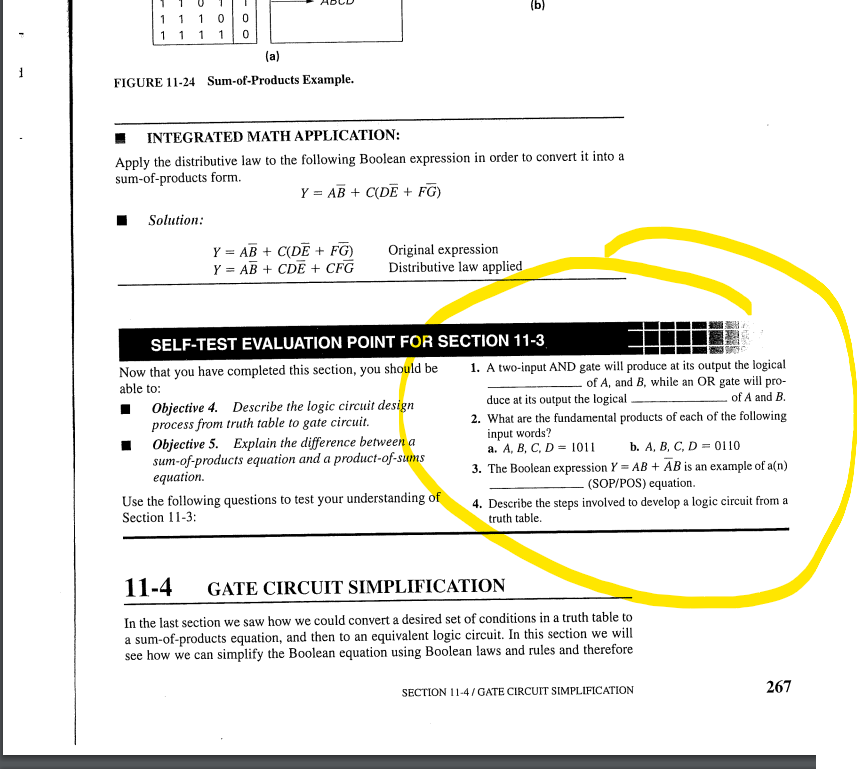
SELFTEST EVALUATION POINT FOR SECTION
Now that you have completed this section, you should be
able to:
Objective Describe the logic circuit design
process from truth table to gate circuit.
Objective Explain the difference between a
sumofproducts equation and a productofsums
equation.
Use the following questions to test your understanding of
Section :
A twoinput AND gate will produce at its output the logical
of and while an OR gate will pro
duce at its output the logical
of A and
What are the fundamental products of each of the following
input words?
a
b
The Boolean expression is an example of an
SOPPOS equation.
Describe the steps involved to develop a logic circuit from a
truth table.
GATE CIRCUIT SIMPLIFICATION
In the last section we saw how we could convert a desired set of conditions in a truth table to
a sumofproducts equation, and then to an equivalent logic circuit. In this section we will
see how we can simplify the Boolean equation using Boolean laws and rules and therefore
Step by Step Solution
There are 3 Steps involved in it
1 Expert Approved Answer
Step: 1 Unlock

Question Has Been Solved by an Expert!
Get step-by-step solutions from verified subject matter experts
Step: 2 Unlock
Step: 3 Unlock
 Study Help