Question: A first step in developing a new product or updating an existing one is understanding what attributes are important to a customer interested in purchasing
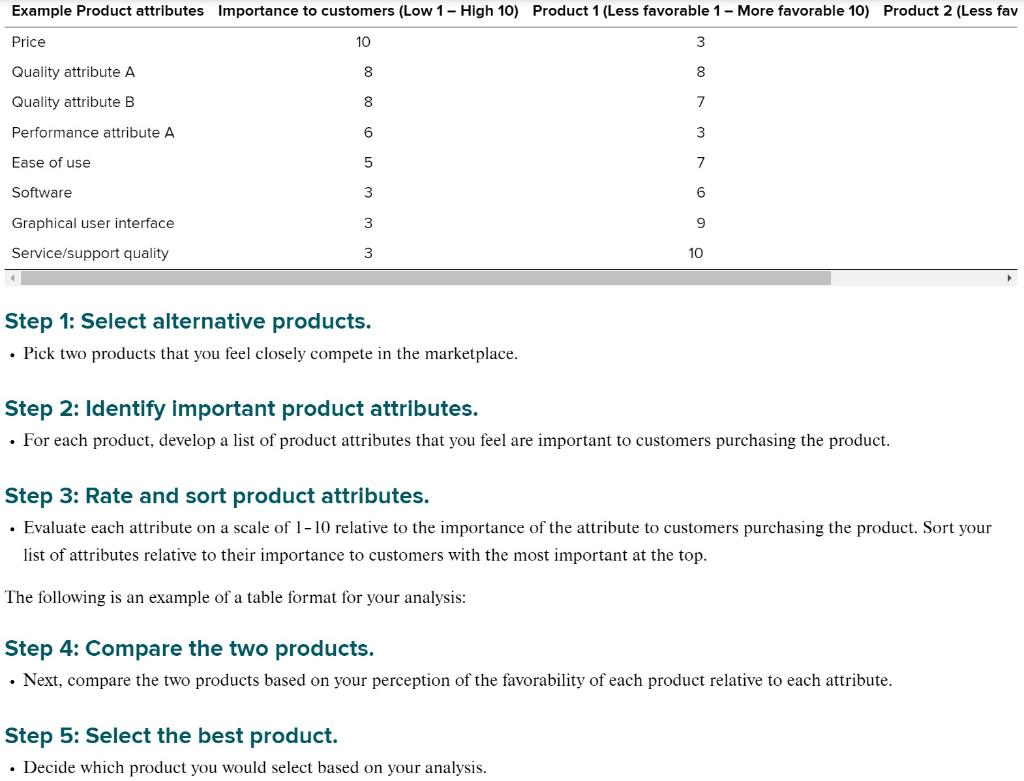

A first step in developing a new product or updating an existing one is understanding what attributes are important to a customer interested in purchasing the product. One approach might be to start from a clean sheet and totally design a new product from scratch. This is often done when new technology is available that would lead to something that is radically different from existing products. For example, recent developments in lithium ion batteries have been incorporated in new all-electric motor vehicles such as the Model S, X, and 3 offered by Tesla Motors. This is an example of the development of a totally new vehicle platform. Different variations of the three Tesla models incorporate many of the same subsystems relative to the motors, batteries, brakes, and other physical modules. Over time, one would expect a company, such as Tesla, to make incremental changes to the basic vehicle platform in response to new technology or other opportunities. Being first-to-market can present an interesting challenge for a company. The development of competing products by companies Page 69 that can see what has been successful in the first-to-market product gives a significant advantage to the follow-up products. Information on performance attributes of the first-to-market product, such as single-charge travel distance, passenger configuration, acceleration, and price for Tesla, is readily available. A company developing a new competing product simply needs to beat the existing benchmark. Performing a comparison of two existing products relative to attributes that are important to prospective customers is often part of the product development process. For example, consider the following comparison of the Tesla Model S to the BMW i8 Coupe. The Tesla Model S is an all-electric, 4-wheel drive sports sedan. The BMW i8 Coupe is a hybrid that combines a 1.5-liter three-cylinder gas-powered engine with a 11.6-kWh battery pack and two electric motors. The hybrid will sprint from zero to 60mph in 4.1 seconds, while the Model S reaches that speed in 2.5 seconds. The Tesla has a battery range of 335 miles while the hybrid has 18 on battery only. There are many other attributes that could be compared. In this exercise, you are to compare two competing products from a customer perspective. Take on the role of a prospective customer who needs to choose between the products. For example, you might consider the purchase of a cell phone by comparing two models that you feel are close competitors. Other examples might be laptop computers or cars. Step 1: Select alternative products. - Pick two products that you feel closely compete in the marketplace. Step 2: Identify important product attributes. - For each product, develop a list of product attributes that you feel are important to customers purchasing the product. Step 3: Rate and sort product attributes. - Evaluate each attribute on a scale of 110 relative to the importance of the attribute to customers purchasing the product. Sort your list of attributes relative to their importance to customers with the most important at the top. The following is an example of a table format for your analysis: Step 4: Compare the two products. - Next, compare the two products based on your perception of the favorability of each product relative to each attribute. Step 5: Select the best product. - Decide which product you would select based on your analysis. Step 6: Make suggestions for product improvements. - Develop a list of suggestions that you might make to the makers of the products that would improve their desirability









 Study Help