







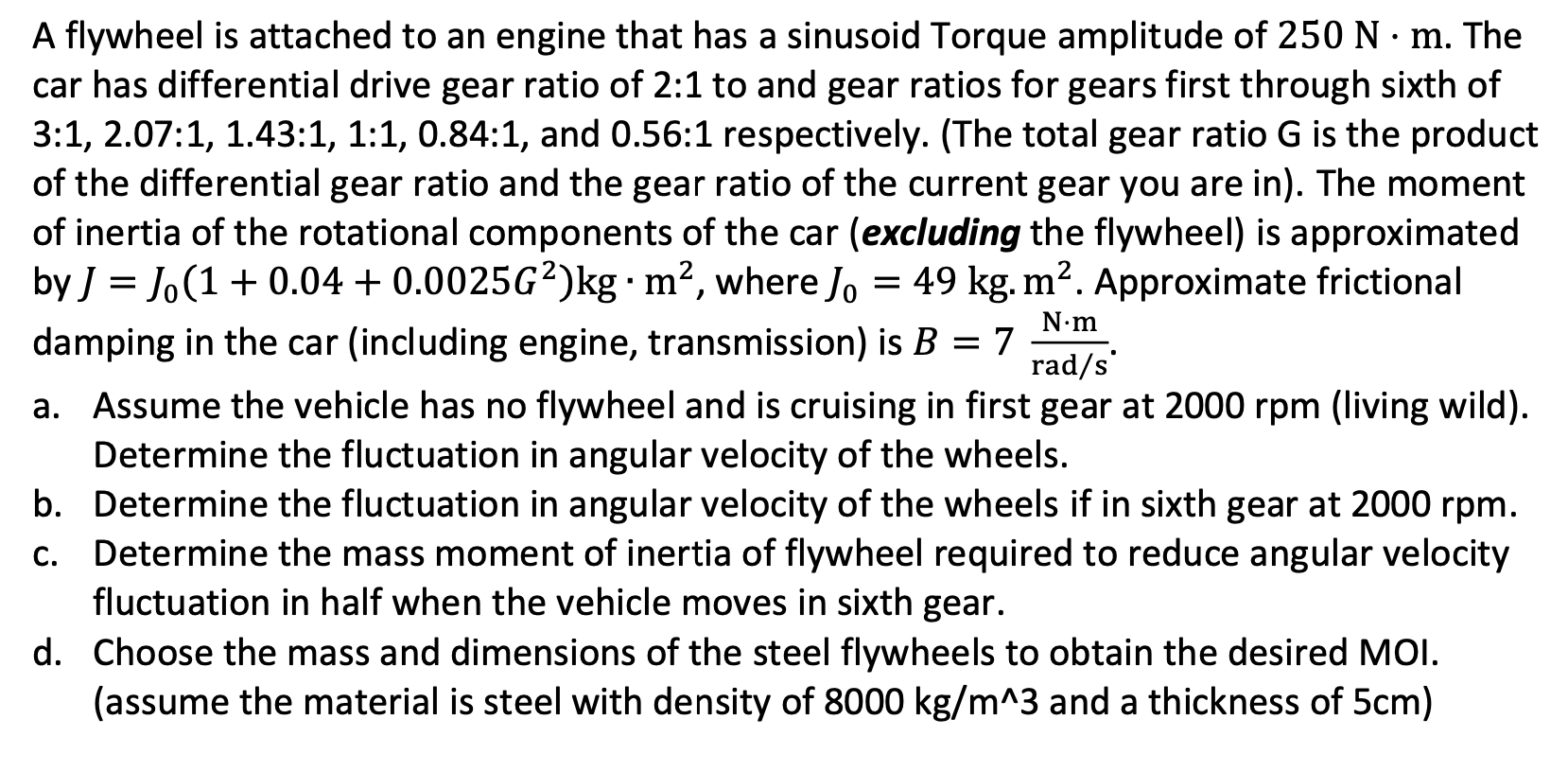
Question: A flywheel is attached to an engine that has a sinusoid Torque amplitude of 2 5 0 N * m . The car has differential
A flywheel is attached to an engine that has a sinusoid Torque amplitude of The
car has differential drive gear ratio of : to and gear ratios for gears first through sixth of
::::: and : respectively. The total gear ratio G is the product
of the differential gear ratio and the gear ratio of the current gear you are in The moment
of inertia of the rotational components of the car excluding the flywheel is approximated
by where Approximate frictional
damping in the car including engine, transmission is
a Assume the vehicle has no flywheel and is cruising in first gear at rpm living wild
Determine the fluctuation in angular velocity of the wheels. ANS:
b Determine the fluctuation in angular velocity of the wheels if in sixth gear at rpm
c Determine the mass moment of inertia of flywheel required to reduce angular velocity
fluctuation in half when the vehicle moves in sixth gear.
d Choose the mass and dimensions of the steel flywheels to obtain the desired MOI.
assume the material is steel with density of and a thickness of cm
Step by Step Solution
There are 3 Steps involved in it
1 Expert Approved Answer
Step: 1 Unlock

Question Has Been Solved by an Expert!
Get step-by-step solutions from verified subject matter experts
Step: 2 Unlock
Step: 3 Unlock
 Study Help