







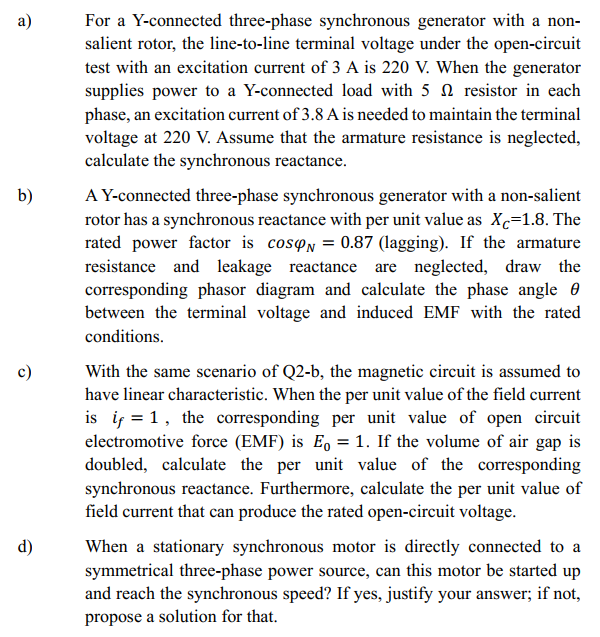
Question: a ) For a Y - connected three - phase synchronous generator with a nonsalient rotor, the line - to - line terminal voltage under
a For a Yconnected threephase synchronous generator with a nonsalient rotor, the linetoline terminal voltage under the opencircuit test with an excitation current of A is V When the generator supplies power to a Yconnected load with Omega resistor in each phase, an excitation current of A is needed to maintain the terminal voltage at V Assume that the armature resistance is neglected, calculate the synchronous reactance.
b A Yconnected threephase synchronous generator with a nonsalient rotor has a synchronous reactance with per unit value as XC The rated power factor is cos varphiNlagging If the armature resistance and leakage reactance are neglected, draw the corresponding phasor diagram and calculate the phase angle theta between the terminal voltage and induced EMF with the rated conditions.
c With the same scenario of Qb the magnetic circuit is assumed to have linear characteristic. When the per unit value of the field current is if the corresponding per unit value of open circuit electromotive force EMF is E If the volume of air gap is doubled, calculate the per unit value of the corresponding synchronous reactance. Furthermore, calculate the per unit value of field current that can produce the rated opencircuit voltage.
d When a stationary synchronous motor is directly connected to a symmetrical threephase power source, can this motor be started up and reach the synchronous speed? If yes, justify your answer; if not, propose a solution for that.
Step by Step Solution
There are 3 Steps involved in it
1 Expert Approved Answer
Step: 1 Unlock

Question Has Been Solved by an Expert!
Get step-by-step solutions from verified subject matter experts
Step: 2 Unlock
Step: 3 Unlock
 Study Help