







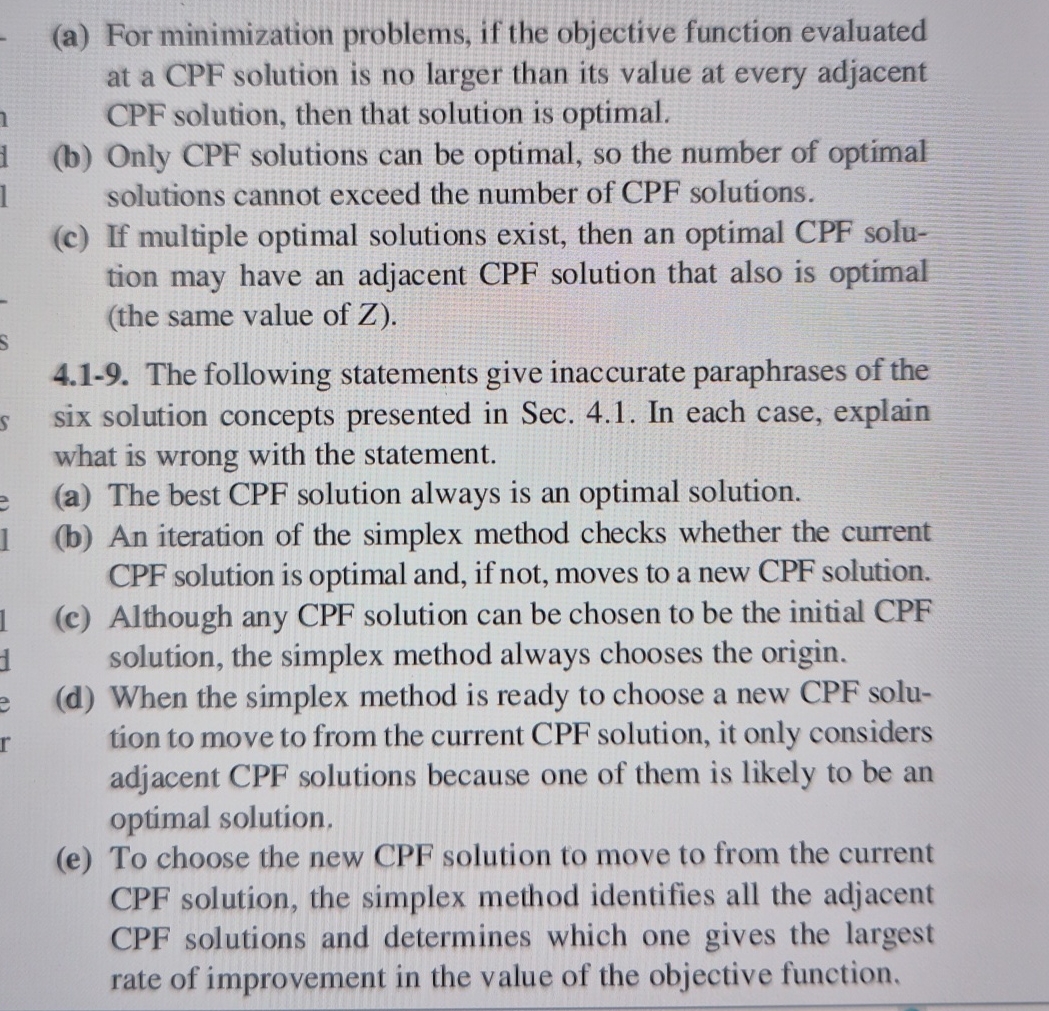
Question: ( a ) For minimization problems, if the objective function evaluated at a CPF solution is no larger than its value at every adjacent CPF
a For minimization problems, if the objective function evaluated at a CPF solution is no larger than its value at every adjacent CPF solution, then that solution is optimal.
b Only CPF solutions can be optimal, so the number of optimal solutions cannot exceed the number of CPF solutions.
c If multiple optimal solutions exist, then an optimal CPF solution may have an adjacent CPF solution that also is optimal the same value of
The following statements give inaccurate paraphrases of the six solution concepts presented in Sec. In each case, explain what is wrong with the statement.
a The best CPF solution always is an optimal solution.
b An iteration of the simplex method checks whether the current CPF solution is optimal and, if not, moves to a new CPF solution.
e Although any CPF solution can be chosen to be the initial CPF solution, the simplex method always chooses the origin.
d When the simplex method is ready to choose a new CPF solution to move to from the current CPF solution, it only considers adjacent CPF solutions because one of them is likely to be an optimal solution.
e To choose the new CPF solution to move to from the current CPF solution, the simplex method identifies all the adjacent CPF solutions and determines which one gives the largest rate of improvement in the value of the objective function.
Step by Step Solution
There are 3 Steps involved in it
1 Expert Approved Answer
Step: 1 Unlock

Question Has Been Solved by an Expert!
Get step-by-step solutions from verified subject matter experts
Step: 2 Unlock
Step: 3 Unlock
 Study Help