







Question: (a) For the Bayesian model given by ( | )~ ( , ) Y Bin n and the prior ~ (,) Beta , find the
(a) For the Bayesian model given by ( | )~ ( , ) Y Bin n and the prior
~ (,) Beta , find the posterior predictive density of a future data
value x, whose distribution is defined by ( | , )~ ( , ) x y Bin m .
(b) A bent coin is tossed 20 times and 6 heads come up. Assuming a flat
prior on the probability of heads on a single toss, what is the probability
that exactly one head will come up on the next two tosses of the same
coin? Answer this using results in (a).Chapter 3: Bayesian Basics Part 3
123
(c) A bent coin is tossed 20 times and 6 heads come up. Assume a
Beta(20.3,20.3) prior on the probability of heads.
Find the expected number of times you will have to toss the same coin
again repeatedly until the next head comes up.
(d) A bent coin is tossed 20 times and 6 heads come up. Assume a
Beta(20.3,20.3) prior on the probability of heads.
Now consider tossing the coin repeatedly until the next head, writing
down the number of tosses, and then doing all of this again repeatedly,
again and again.
The result will be a sequence of natural numbers (for example
3, 1, 1, 4, 2, 2, 1, 5, 1, ....), where each number represents a number of
tails in a row within the sequence, plus one.
Next define to be the average of a very long sequence like this (e.g.
one of length 1,000,000). Find the posterior predictive density and mean
of (approximately)
6. Let X1, X2, X3 be a random sample from the uniform distribution on the
interval (0, 1). What is the probability that the sample median is less than
0.4?
7. Let X1, X2, X3, X4, X5 be a random sample from the uniform distribution
on the interval (0, ), where is unknown, and let Xmax denote the largest
observation. For what value of the constant k, the expected value of the
random variable kXmax is equal to ?
8. A random sample of size 16 is to be taken from a normal population having
mean 100 and variance 4. What is the 90th percentile of the distribution of
the sample mean?
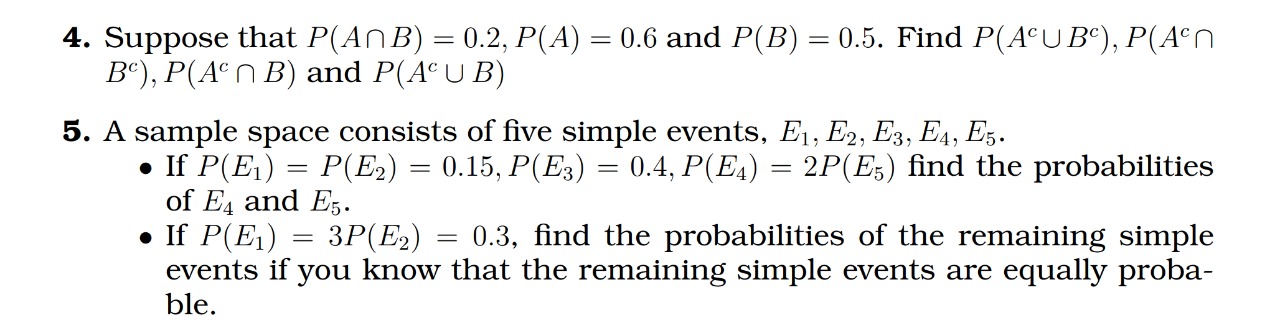
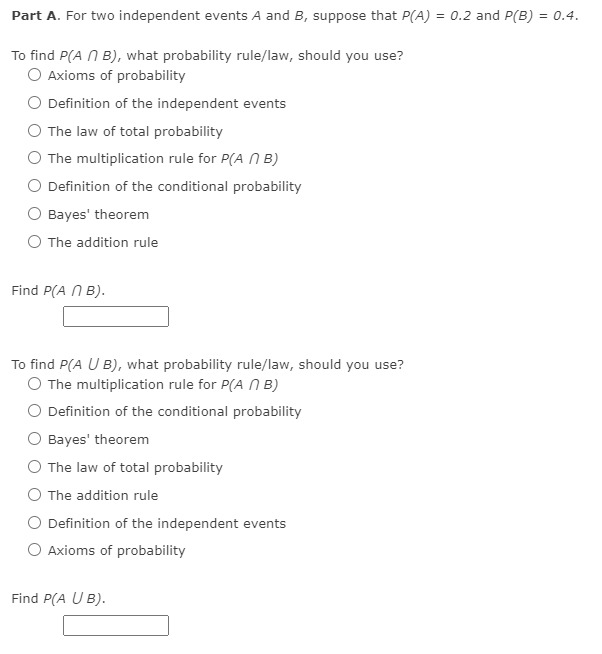
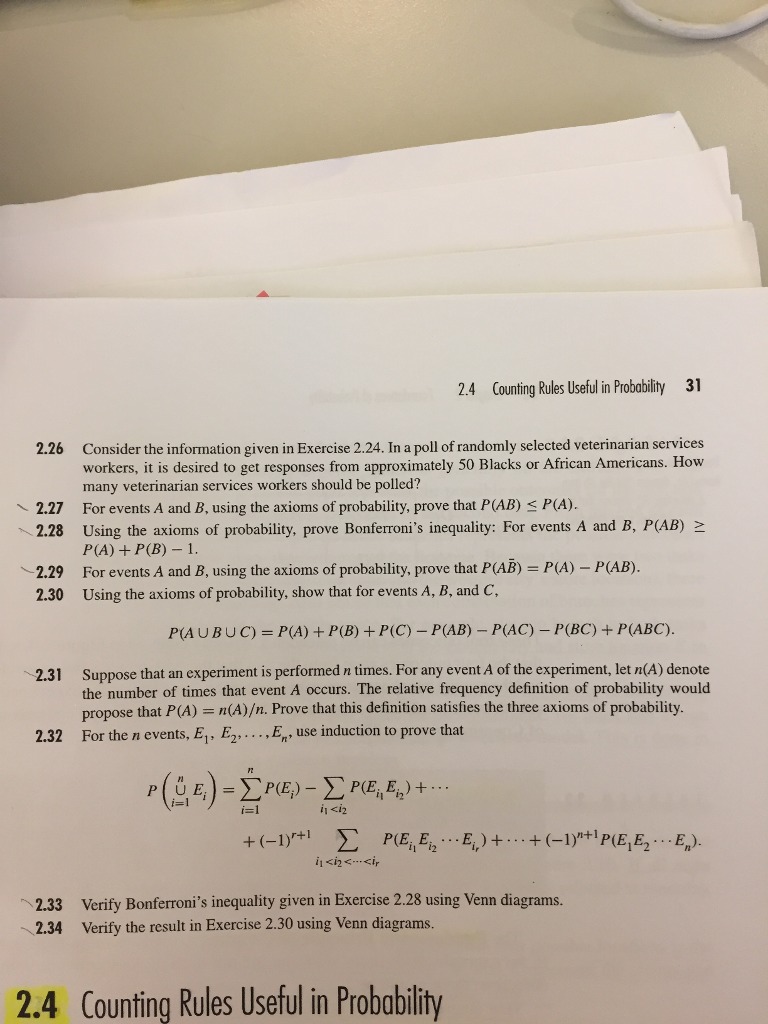
4. Suppose that P(An B) = 0.2, P(A) = 0.6 and P(B) = 0.5. Find P(AcUBC), P(Acn B"), P(An B) and P(AUB) 5. A sample space consists of five simple events, E1, E2, E3, E4, Es. . If P(E1) = P(E2) = 0.15, P(E3) = 0.4, P(E4) = 2P(Es) find the probabilities of E4 and Es. . If P(E1) = 3P(E2) = 0.3, find the probabilities of the remaining simple events if you know that the remaining simple events are equally proba- ble.Part A. For two independent events A and B, suppose that P(A) = 0.2 and P(B) = 0.4. To find P(A /7 B), what probability rule/law, should you use? O Axioms of probability O Definition of the independent events O The law of total probability O The multiplication rule for P(A / B) O Definition of the conditional probability O Bayes' theorem O The addition rule Find P(A /) B). To find P(A U B), what probability rule/law, should you use? O The multiplication rule for P(A / B) O Definition of the conditional probability O Bayes' theorem O The law of total probability O The addition rule O Definition of the independent events O Axioms of probability Find P(A U B).2.4 Counting Rules Useful in Probability 31 2.26 Consider the information given in Exercise 2.24. In a poll of randomly selected veterinarian services workers, it is desired to get responses from approximately 50 Blacks or African Americans. How many veterinarian services workers should be polled? 2.27 For events A and B, using the axioms of probability, prove that P(AB) P(A) + P(B) - 1. 2.29 For events A and B, using the axioms of probability, prove that P(AB) = P(A) - P(AB). 2.30 Using the axioms of probability, show that for events A, B, and C, P(AUBUC) = P(A) + P(B) + P(C) - P(AB) - P(AC) - P(BC) + P(ABC). 2.31 Suppose that an experiment is performed n times. For any event A of the experiment, let n(A) denote the number of times that event A occurs. The relative frequency definition of probability would propose that P(A) = n(A). Prove that this definition satisfies the three axioms of probability. 2.32 For the n events, E1, Ez, . .., E,,, use induction to prove that P ( U E , ) = [ P (E; ) - [ P(E; En ) + .. 1= 1 in
Step by Step Solution
There are 3 Steps involved in it

Get step-by-step solutions from verified subject matter experts
 Study Help