







Question: A formula in financial analysis is Return on equity = net profit margin total asset turnover equity multiplier. Suppose that the equity multiplier is fixed
A formula in financial analysis is Return on equity net profit margin total asset turnover equity multiplier. Suppose that the equity multiplier is fixed
at but that the net profit margin is normally distributed with a mean of and a standard deviation of and that the total asset turnover is
normally distributed with a mean of and a standard deviation of Set up and conduct a sampling experiment to find the distribution of the return
on equity. Show how the results as a histogram would help explain your analysis and conclusions.
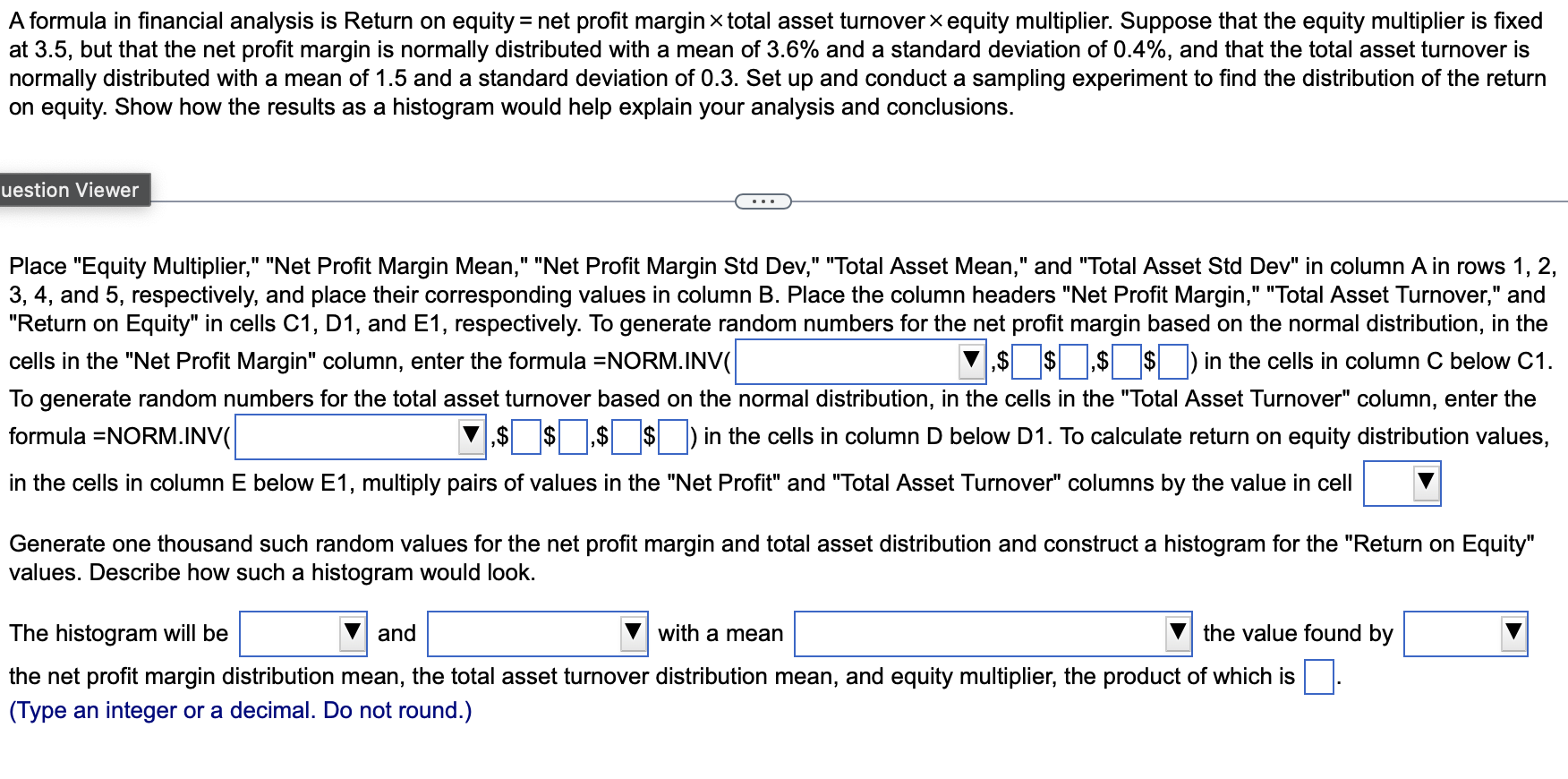
Place "Equity Multiplier," "Net Profit Margin Mean," "Net Profit Margin Std Dev," "Total Asset Mean," and "Total Asset Std Dev" in column A in rows
and respectively, and place their corresponding values in column B Place the column headers "Net Profit Margin," "Total Asset Turnover," and
"Return on Equity" in cells C D and E respectively. To generate random numbers for the net profit margin based on the normal distribution, in the
cells in the "Net Profit Margin" column, enter the formula NORM.INV$ $$$ in the cells in column C below C
To generate random numbers for the total asset turnover based on the normal distribution, in the cells in the "Total Asset Turnover" column, enter the
formula NORM.INV$$$$ in the cells in column D below D To calculate return on equity distribution values,
in the cells in column E below E multiply pairs of values in the "Net Profit" and "Total Asset Turnover" columns by the value in cell
Generate one thousand such random values for the net profit margin and total asset distribution and construct a histogram for the "Return on Equity"
values. Describe how such a histogram would look.
The histogram will be and a the value found by
the net profit margin distribution mean, the total asset turnover distribution mean, and equity multiplier, the product of which is
Type an integer or a decimal. Do not round.
Step by Step Solution
There are 3 Steps involved in it
1 Expert Approved Answer
Step: 1 Unlock

Question Has Been Solved by an Expert!
Get step-by-step solutions from verified subject matter experts
Step: 2 Unlock
Step: 3 Unlock
 Study Help