







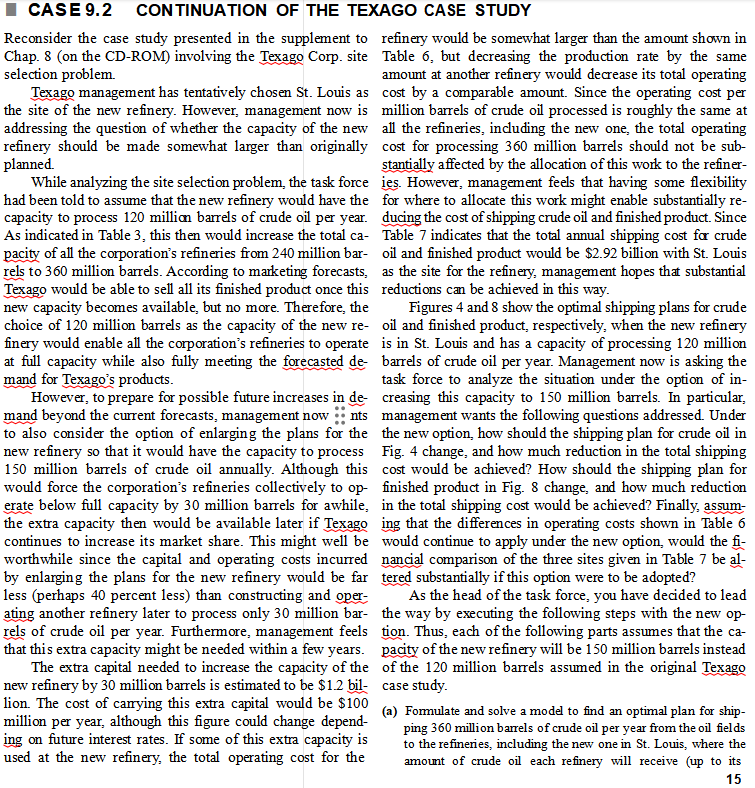
Question: ( a ) Formulate and solve a model to find an optimal plan for ship - ping 3 6 0 million barrels of crude oil
a Formulate and solve a model to find an optimal plan for ship ping million barrels of crude oil per year from the oil fields to the refineries, including the new one in St Louis, where the amount of crude oil each refinery will receive up to its
ADDITIONAL CASES
capacity is based on minimizing the total annual cost for these shipments. Hint: If you are using a spreadsheet model, you can save some time in this and subsequent parts by using the live spreadsheets for the Texago case study in this chapters Excel files as a starting point and then making the adjustments needed to reflect the increased capacity of the new refinery. Compare the resulting total annual cost for these shipments with the results obtained in Fig. under the original assump tion of a smaller refinery in St Louis.
b Assume that the plan found in part a will be used. Since this plan specifies how much crude oil each refinery will receive, it also dictates how much final product each refinery will supply. On this basis, formulate and solve a model to find an optimal plan for shipping finished product from the refineries to the dis tribution centers. Compare the resulting total annual cost for these shipments with the results obtained in Fig. Also cal culate the total annual cost of shipping both crude oil and fin ished product under this plan and compare it with the corre sponding total of $ billion obtained from Table
c You realize that the cost of shipping final product tends to be somewhat larger than the cost of shipping crude oil. Therefore, rather than having the decisions on the amount of crude oil each refinery will receive and process be dictated by minimizing the total annual cost of shipping crude oil as in parts a and b you decide to check on what would happen if these decisions are based on minimizing the total annual cost of shipping final product instead. Formulate and solve a model to find an optimal plan for shipping final product from the refineries including the new one in St Louis to the distribution centers, where the al location of the million barrels of crude oil per year to the refineries is based on minimizing the total annual cost for these shipments. Compare the resulting total annual cost for these ship ments with the results obtained in part b and in Fig.
d Assume that the plan found in part c will be used. Since this plan specifies how much final product each refinery will ship, it also dictates how much crude oil each refinery will receive. On this basis, formulate and solve a model to find an optimal
plan for shipping crude oil from the oil fields to the refineries. Compare the resulting total annual cost for these shipments with the results obtained in part a and in Fig. Also calculate the total annual cost of shipping both crude oil and finished prod uct under this plan, and compare it with the corresponding to tal obtained in part b and in Table
e You realize that, so far, you have been only suboptimizing the over all problem by optimizing only one part of the problem at a time, so now it is time to get down to serious business. Formulate a sin gle linear programming model that simultaneously considers the shipping of million barrels of crude oil per year from the oil fields to the refineries including the new one in St Louis and the shipping of final product from the refineries to the distribution centers. Use the objective of minimizing the grand total of all these shipping costs. This kind of linear programming problem is re ferred to as a transshipment problem. Since the refineries collec tively have a capacity of processing million barrels of crude oil per year, the decisions on the amount of crude oil each refin ery will receive and process up to its capacity also is to be based on this same objective. Solve the model and compare the result ing total of all the shipping costs with the corresponding total cal culated in parts b and d and from Table
f Repeat part e if the new refinery with a capacity of process ing million barrels of crude oil per year were to be placed in Los Angeles instead of St Louis. Then repeat it again if Galveston were to be selected as the site instead. Using the op erating costs given in Table for the three sites, construct a table like Table to show the new financial comparison between the sites. Although the operating costs will be larger than given in Table if the new refinery processes more than million bar rels of crude oil per year, management has instructed the task force to assume that the differences in operating costs shown in Table would continue to apply, so the differences in the total variable costs in the table being constructed would still be valid.
g You now are ready to submit all your results to management.
Write an accompanying memorandum that summarizes your re sults and rec
Step by Step Solution
There are 3 Steps involved in it
1 Expert Approved Answer
Step: 1 Unlock

Question Has Been Solved by an Expert!
Get step-by-step solutions from verified subject matter experts
Step: 2 Unlock
Step: 3 Unlock
 Study Help