







Question: A function f(x) is said to have a removable discontinuity at a = a if: 1. f is either not defined or not continuous at
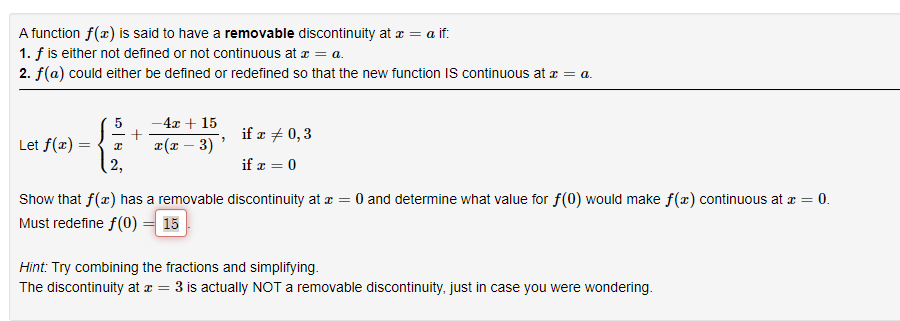
A function f(x) is said to have a removable discontinuity at a = a if: 1. f is either not defined or not continuous at I = a. 2. f(a) could either be defined or redefined so that the new function IS continuous at r = a. 4x + 15 + if x * 0,3 Let f(x) = r(- 3) 2, if x = 0 Show that f(@) has a removable discontinuity at a = 0 and determine what value for f(0) would make f( ) continuous at x = 0. Must redefine f(0) = 15 Hint: Try combining the fractions and simplifying. The discontinuity at * = 3 is actually NOT a removable discontinuity, just in case you were wondering
Step by Step Solution
There are 3 Steps involved in it
1 Expert Approved Answer
Step: 1 Unlock

Question Has Been Solved by an Expert!
Get step-by-step solutions from verified subject matter experts
Step: 2 Unlock
Step: 3 Unlock
 Study Help