







Question: $$ A function is said to have a horizontal asymptote if either the limit at infinity exists or the limit at negative infinity exists. Show
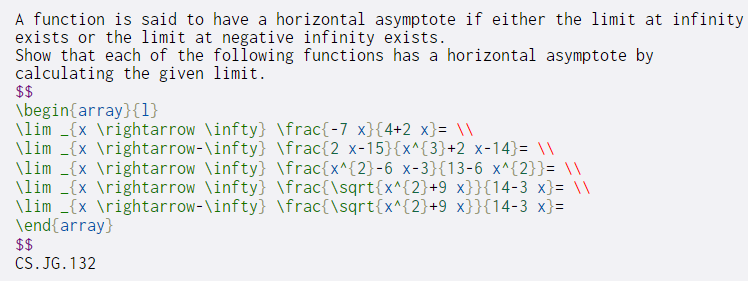
$$ A function is said to have a horizontal asymptote if either the limit at infinity exists or the limit at negative infinity exists. Show that each of the following functions has a horizontal asymptote by calculating the given limit. \begin{array}{1} \lim _{x ightarrow \infty} \frac{-7 x}{4+2 x}= \\ \lim _{x ightarrow-\infty} \frac{2 x-15}{x^{3}+2 x-14}= \lim _{x ightarrow \infty} \frac{x^{2}-6 x-3}{13-6 x^{2}}= " \lim _{x ightarrow \infty} \frac{\sqrt{x^{2}+9 x}}{14-3 x}= \ \lim _{x ightarrow-\infty} \frac{\sqrt{x^{2}+9 x}}{14-3 x}= \end{array} $$ CS.JG.132
Step by Step Solution
There are 3 Steps involved in it
1 Expert Approved Answer
Step: 1 Unlock

Question Has Been Solved by an Expert!
Get step-by-step solutions from verified subject matter experts
Step: 2 Unlock
Step: 3 Unlock
 Study Help