



Question: A fund manager manages two portfolios, A and B . The individual portfolios have expected returns of E [ r A ] = 6 .
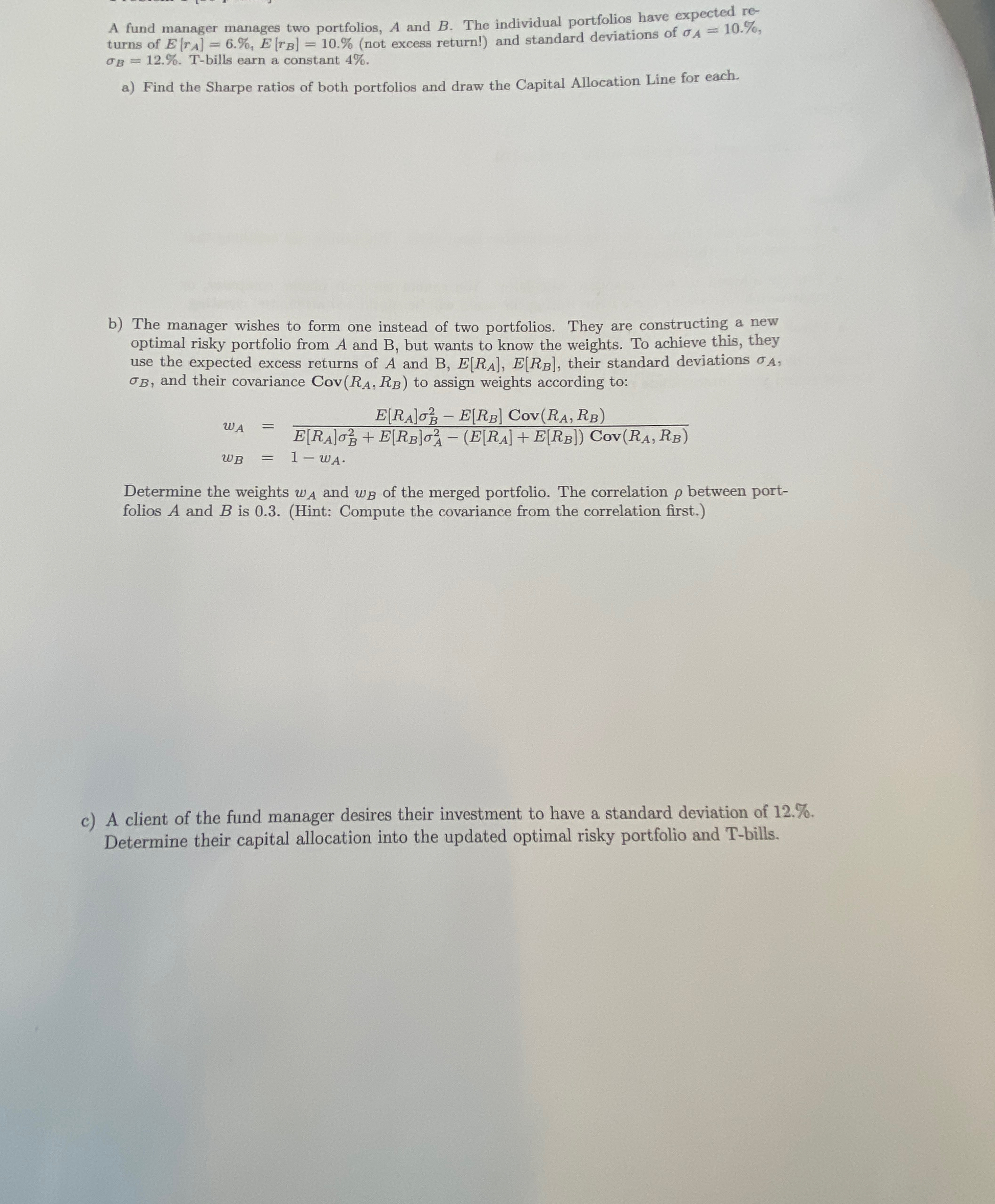
A fund manager manages two portfolios, A and The individual portfolios have expected returns of not excess return! and standard deviations of Tbills earn a constant
a Find the Sharpe ratios of both portfolios and draw the Capital Allocation Line for each.
b The manager wishes to form one instead of two portfolios. They are constructing a new optimal risky portfolio from A and but wants to know the weights. To achieve this, they use the expected excess returns of A and their standard deviations and their covariance Cov to assign weights according to:
Determine the weights and of the merged portfolio. The correlation between portfolios A and is Hint: Compute the covariance from the correlation first.
c A client of the fund manager desires their investment to have a standard deviation of Determine their capital allocation into the updated optimal risky portfolio and Tbills.
Step by Step Solution
There are 3 Steps involved in it
1 Expert Approved Answer
Step: 1 Unlock

Question Has Been Solved by an Expert!
Get step-by-step solutions from verified subject matter experts
Step: 2 Unlock
Step: 3 Unlock