







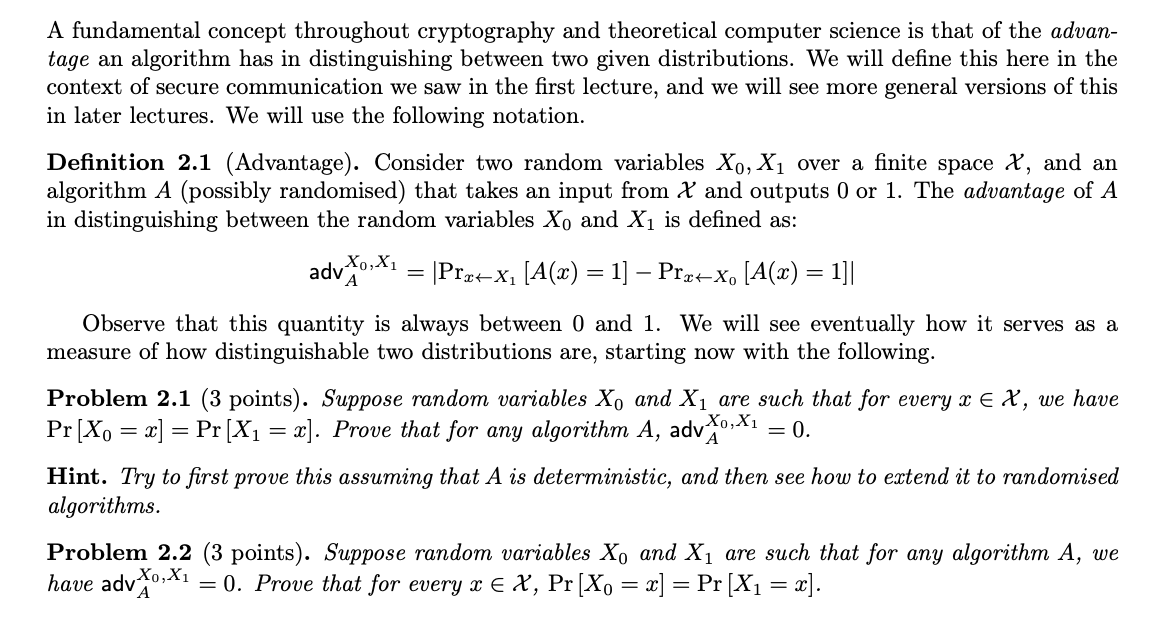
Question: A fundamental concept throughout cryptography and theoretical computer science is that of the advan - tage an algorithm has in distinguishing between two given distributions.
A fundamental concept throughout cryptography and theoretical computer science is that of the advan
tage an algorithm has in distinguishing between two given distributions. We will define this here in the
context of secure communication we saw in the first lecture, and we will see more general versions of this
in later lectures. We will use the following notation.
Definition Advantage Consider two random variables over a finite space and an
algorithm possibly randomised that takes an input from and outputs or The advantage of
in distinguishing between the random variables and is defined as:
Observe that this quantity is always between and We will see eventually how it serves as a
measure of how distinguishable two distributions are, starting now with the following.
Problem points Suppose random variables and are such that for every xinx, we have
Prove that for any algorithm
Hint. Try to first prove this assuming that is deterministic, and then see how to extend it to randomised
algorithms.
Problem points Suppose random variables and are such that for any algorithm we
have Prove that for every xinx,
Step by Step Solution
There are 3 Steps involved in it
1 Expert Approved Answer
Step: 1 Unlock

Question Has Been Solved by an Expert!
Get step-by-step solutions from verified subject matter experts
Step: 2 Unlock
Step: 3 Unlock
 Study Help