







Question: A game theory question Question 5: Consider the first-price sealed bid auction where an object is up for sale and there are n buyers each
A game theory question
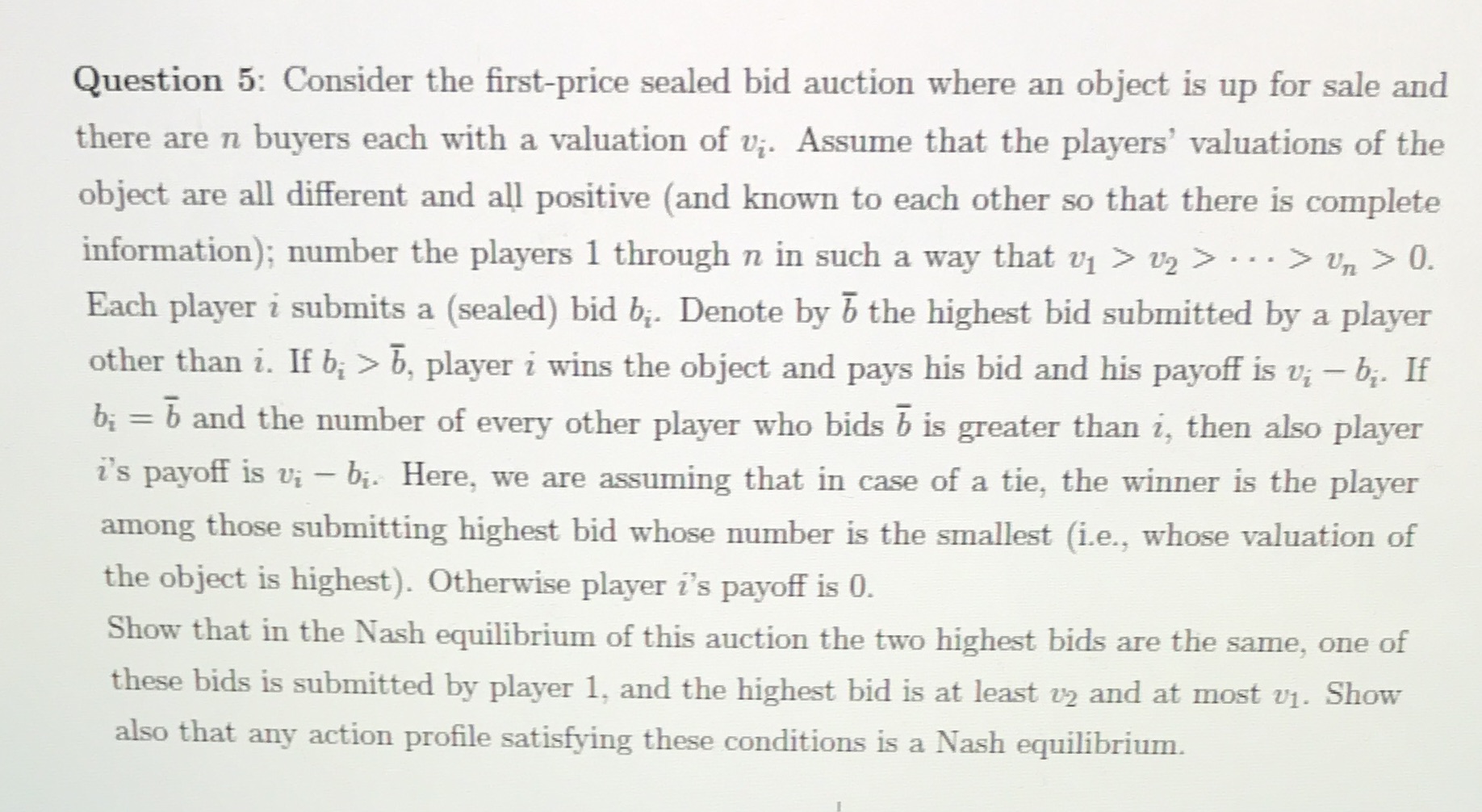
Question 5: Consider the first-price sealed bid auction where an object is up for sale and there are n buyers each with a valuation of v;. Assume that the players' valuations of the object are all different and all positive (and known to each other so that there is complete information); number the players 1 through n in such a way that v1 > v2 > . . . > Un > 0. Each player i submits a (sealed) bid b;. Denote by b the highest bid submitted by a player other than i. If b; > b, player i wins the object and pays his bid and his payoff is v; - b;. If b; = b and the number of every other player who bids b is greater than i, then also player i's payoff is vi - bi. Here, we are assuming that in case of a tie, the winner is the player among those submitting highest bid whose number is the smallest (i.e., whose valuation of the object is highest). Otherwise player i's payoff is 0. Show that in the Nash equilibrium of this auction the two highest bids are the same, one of these bids is submitted by player 1, and the highest bid is at least v2 and at most v1. Show also that any action profile satisfying these conditions is a Nash equilibrium
Step by Step Solution
There are 3 Steps involved in it

Get step-by-step solutions from verified subject matter experts
 Study Help